
Ten Days to 420 and the Feds Cannot Stop Contradicting Themselves
Every time you think you understand federal cannabis policy, another agency proves you wrong.
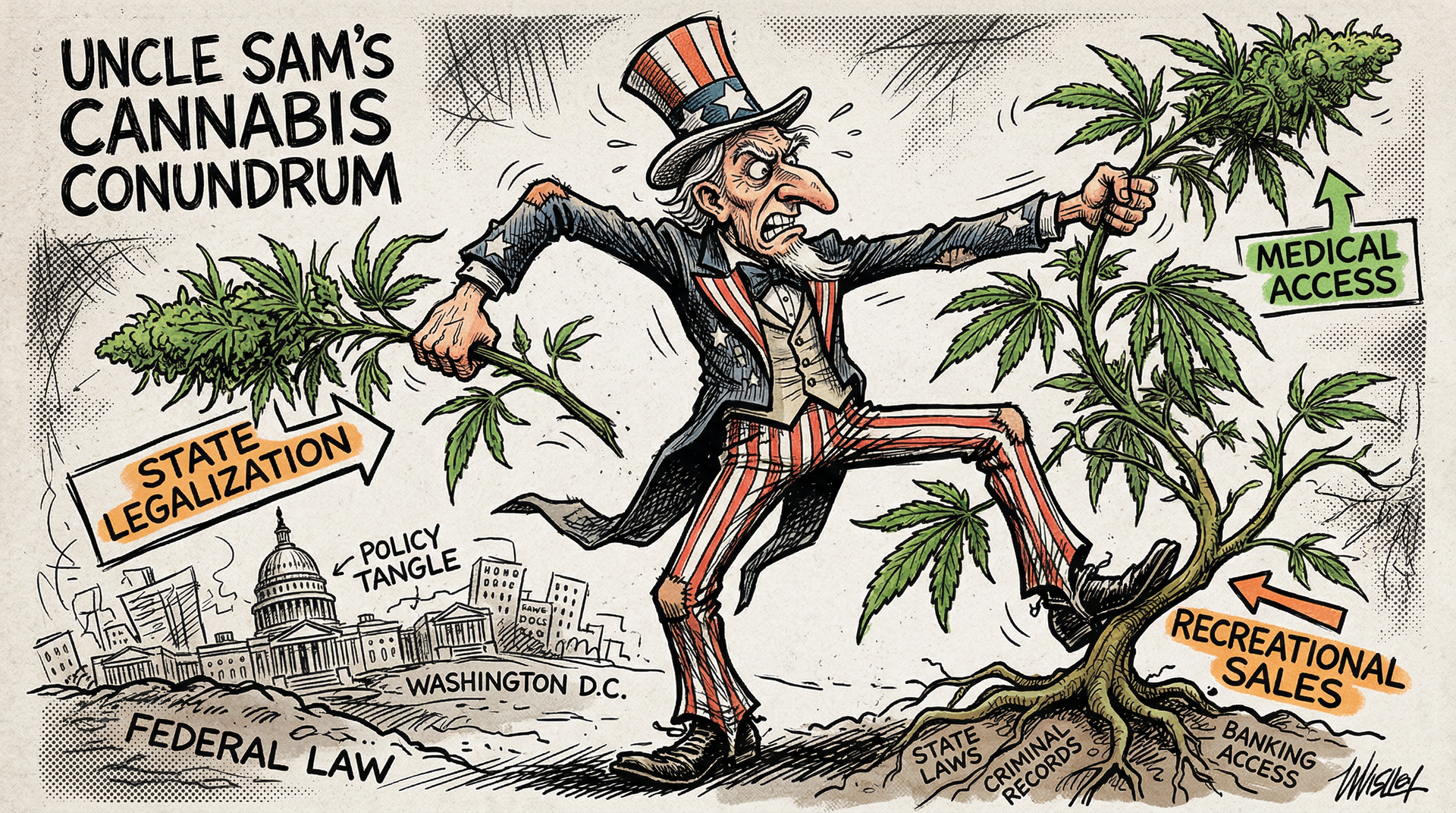
Ten days to 4/20 and the federal government is running three different cannabis policies at the same time.
This week, President Trump included a rider in his proposed federal budget that would continue protections for state medical cannabis programs from federal interference. This is the first time Trump has proposed maintaining these protections after previously suggesting their deletion in earlier budget requests. Medical cannabis is safe from federal enforcement. That is the official position of the White House as of this week.
At the same time, the same budget proposal includes language blocking Washington D.C. from using its funds to legalize recreational cannabis sales. The nation's capital, where residents voted overwhelmingly to legalize in 2014, still cannot establish a commercial market because Congress controls D.C.'s budget and keeps inserting this rider.
And then the FBI decided to join the party. The bureau declassified a guidance memo this week that prohibits agents from investing in or working at marijuana companies -- but explicitly allows involvement with hemp and CBD businesses. Unless the packaging depicts a cannabis leaf. If your hemp product has a leaf on the label, the FBI considers that "promotion of marijuana" and agents must stay away.
Protect medical cannabis. Block D.C. from regulating it. Allow hemp but not if the box has the wrong picture on it. This is what federal cannabis policy looks like in April 2026.
The Budget Rider That Speaks Volumes
The medical cannabis protection rider is not new legislation. It has been included in federal spending bills since 2014, originally as the Rohrabacher-Blumenauer amendment. It prevents the Department of Justice from spending federal funds to interfere with state medical cannabis programs that operate in compliance with their own laws.
What makes this year different is who is proposing it. Trump suggested removing the rider from his budget proposals in his first term. Now he is actively including it. The shift signals that even an administration with no clear pro-cannabis legislative agenda recognizes that attacking state medical programs is politically untenable.
There are 38 states with some form of medical cannabis law. The programs serve millions of patients. The rider is a bare minimum -- it does not protect adult-use markets, does not address banking, does not touch rescheduling. But it keeps federal prosecutors from shutting down state medical dispensaries, and the fact that Trump is including it without being forced to is a meaningful data point about where the politics have moved.
The Ohio Surprise and the Massachusetts Overhaul
An Ohio judge issued a temporary restraining order this week blocking enforcement of the state's new hemp product restrictions. The order comes after industry groups challenged the regulations as overly broad and potentially unconstitutional. This is the same set of restrictions that passed after the referendum campaign fell short on signatures earlier this year. The legal fight is far from over, but the TRO means products stay on shelves while the courts sort it out.
In Massachusetts, the legislature's conference committee approved a major cannabis reform bill that would double the amount of marijuana a person can legally possess and overhaul the Cannabis Control Commission. The bill addresses complaints about the commission's oversight, internal governance, and the pace of license approvals that has frustrated operators for years.
This is happening at the same time that cannabis businesses in the state are suing to keep the repeal initiative off the November ballot. Massachusetts is simultaneously defending legalization in court and expanding it through the legislature. The dual-track approach shows how deeply embedded cannabis reform has become in the state's policy infrastructure.
When Research Meets the Real World
The House Small Business Committee heard testimony this week from a father whose child has a terminal illness. He described how cannabis has been the only treatment that has provided meaningful relief for his child's symptoms. His testimony focused on how marijuana rescheduling could unlock research and healing for rare diseases, particularly in pediatric cases where conventional treatments have failed.
This is not abstract policy. This is a parent telling Congress that the federal scheduling of cannabis is the barrier between his dying child and a potential treatment.
The evidence base for cannabis and pediatric epilepsy is the strongest in all of cannabis medicine. Epidiolex, a CBD-derived medication, was FDA-approved in 2018 for Dravet syndrome and Lennox-Gastaut syndrome -- two severe forms of childhood epilepsy that resist virtually every other treatment. The drug has helped thousands of children who had no other options.
But Epidiolex is one formulation for a narrow set of conditions. Parents of children with other rare diseases, other forms of treatment-resistant epilepsy, and other terminal conditions cannot access the research that might help their children because the federal classification makes it extraordinarily difficult to study cannabis in clinical trials.
A 2025 review in Epilepsy and Behavior examined 14 studies of cannabis-based treatments for treatment-resistant epilepsy beyond the conditions Epidiolex is approved for. The review found clinically meaningful seizure reductions in 10 of the 14 studies, including conditions like tuberous sclerosis complex, CDKL5 deficiency, and Angelman syndrome. The researchers noted that the most significant barrier to definitive conclusions was the limited scale of studies -- which is a direct consequence of Schedule I classification making large trials almost impossible to conduct.
Rescheduling would not instantly solve this. But it would remove the most significant regulatory barrier to conducting the research that these families need. 113 days since the executive order. The father who testified this week should not have to beg.
The Final Countdown Begins
Ten days to 4/20. Three days until the Spanberger deadline on April 13 -- the Virginia Cannabis Control Authority is hiring, which is the strongest signal yet that she signs. Ten days until the Medicare CBD preliminary injunction hearing, also on 4/20. The New Jersey hemp grace period ends April 13. Ohio's TRO keeps products on shelves. Massachusetts is doubling down.
Solana is trading in the low $80s. The crypto market continues to process the tariff whipsaw. Weedcoin is nine days into year two and the blog has not missed a day.
The culture keeps building. The countdown keeps running.
Chat with Wiz about any of this: https://bit.ly/ChatWithWeedcoin
Stay connected with the Weedcoin OG community:
Website: https://www.weedcoinog.com
Follow us on X: https://x.com/weedcoinog
Chat With Wiz (GPT): https://bit.ly/ChatWithWeedcoin
Contract Address: 21nnfR4TkbZNLwvRrqEseAbz7P3kxKjaV7KuboLJpump
Like bitcoin but way higher