Terpenes Deep Dive: Why Myrcene, Limonene, Pinene Hit Different
Why two strains at the same THC percentage can feel totally different.
Walk into any dispensary in 2026 and you will see two numbers on every jar: THC percentage and price. That's it. Two numbers trying to describe a plant that has been part of human life for thousands of years. It's like shopping for wine by alcohol content alone. You'd miss everything that matters.
The real story is printed smaller on the label, or sometimes not printed at all. It's the terpene profile. The aromatic compounds that make one Blue Dream cut feel like a clear mountain morning and another cut of the exact same strain hit like a weighted blanket. Same plant name, same THC number, completely different experience. Terpenes are why.
This is the Craft edition. Time to get past the THC arms race and talk about what's actually happening in the jar.
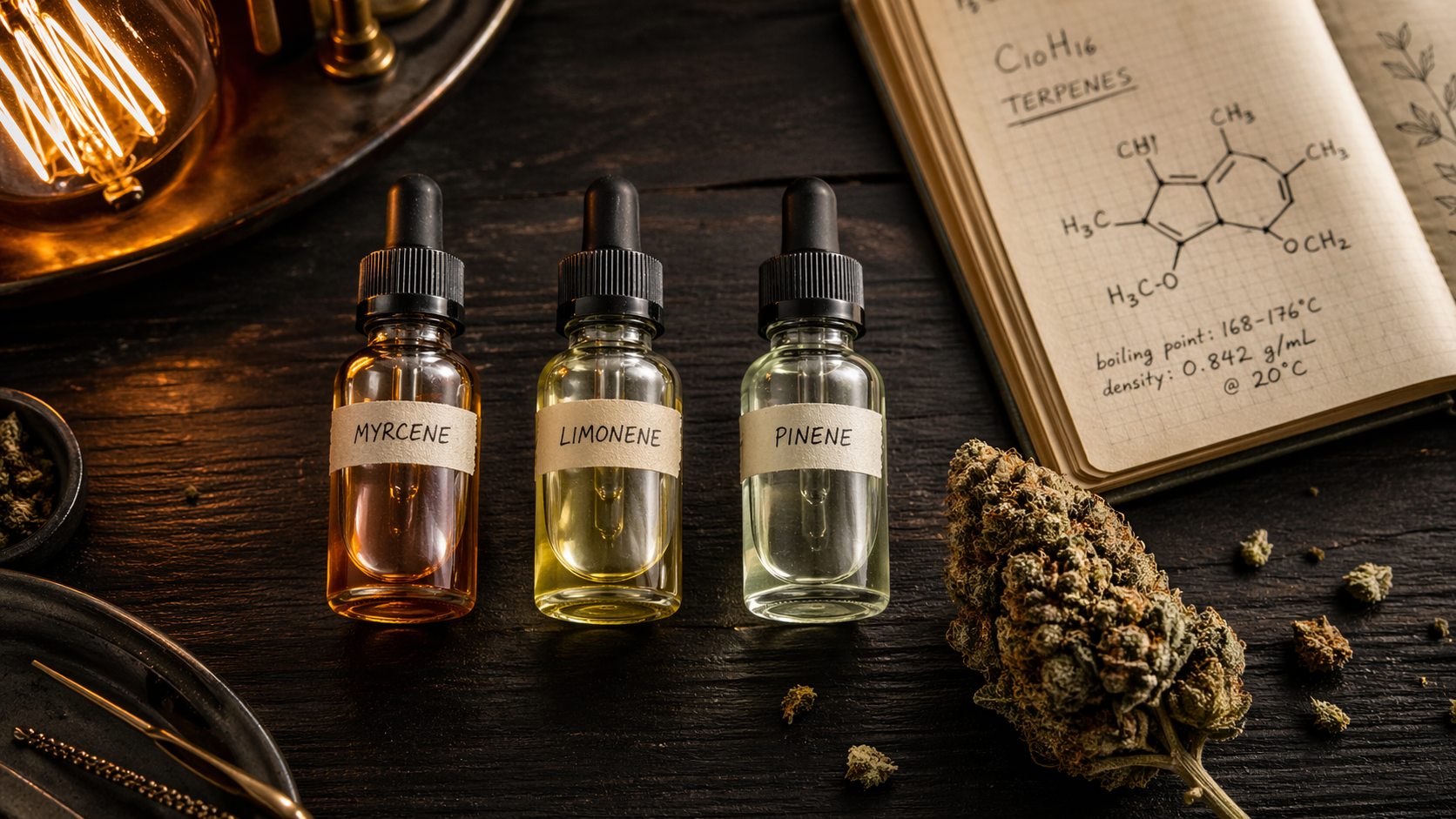
What Terpenes Actually Are
Terpenes are the aromatic oils produced by trichomes, the frosty crystals that cover cannabis flower. Every plant on earth makes terpenes of some kind. Pine trees. Citrus peels. Lavender fields. Black pepper. Cannabis just happens to be one of the most terpene-rich plants ever cultivated, with over 200 different terpenes identified across cultivars.
Here's the twist that researchers spent decades missing. Terpenes can't get you high on their own. They lack the molecular structure to bind to CB1 receptors the way THC does. But they dramatically shape how THC and CBD feel once they're in your system. A 2025 review in Scientific Reports found that terpenes activate cannabinoid receptors at only 10 to 50 percent of THC's activity on their own, yet they modulate bioavailability, membrane permeability, and neurotransmitter signaling in ways that change the whole ride.
That phenomenon has a name: the entourage effect. First described by Mechoulam and Ben-Shabat in 1998, it's the reason full-spectrum products feel different from isolate, and why an old-school landrace strain with lower THC can feel more medicinal than a modern 32 percent hybrid. The cannabinoids do the heavy lifting. The terpenes steer the car.
Myrcene: The Sedative Workhorse
Myrcene is usually the most abundant terpene in cannabis. In some cultivars it makes up 40 to 65 percent of the total terpene profile. If you've smelled that earthy, musky, slightly fruity funk that hits you the moment you open a good jar, that's myrcene.
It's also the terpene most responsible for what stoners have always called couch-lock.
Research shows myrcene is highly lipophilic, meaning it crosses the blood-brain barrier fast and helps THC cross faster. A 2025 formulation study from the University of Arizona found that myrcene enhances THC penetration into the brain without crossing in significant quantities itself. In plain English: myrcene doesn't just add to the ride, it opens the door for THC to hit harder.
Preclinical research has shown myrcene engaging TRPV1 pain channels, opioid receptors, and adenosine pathways. Animal studies point to sedative and muscle-relaxant properties, which lines up with what patients have reported for decades. Myrcene-dominant strains like Granddaddy Purple, OG Kush, and Blue Dream have long been go-to choices for insomnia, chronic pain, muscle spasms, and PTSD-related hyperarousal.
If you need to be functional, myrcene-heavy flower in the middle of the day is a bad move. If you need to sleep, it's one of the best tools the plant offers.
Limonene: The Anxiety Off-Ramp
Limonene smells like citrus peel because it is literally the same compound that makes citrus peel smell like citrus peel. Lemons, oranges, grapefruit. It's one of the most studied terpenes in cannabis, and 2024 changed everything we thought we knew about it.
Dr. Ryan Vandrey's team at Johns Hopkins Medicine ran the first serious human clinical trial on d-limonene and THC. They vaporized THC alone, d-limonene alone, both together, and a placebo, across 20 healthy adults in as many as 10 sessions each. The results, published in the Journal of Drug and Alcohol Dependence, were the kind of finding the industry had been waiting on for twenty years.
When limonene was added to THC, participants reported significantly lower anxiety and paranoia compared to THC alone. The higher the limonene dose, the bigger the anxiety reduction. And here's the part that matters: limonene did not blunt any of the desired THC effects. The cognitive, physiological, and subjective benefits of THC stayed intact. Only the anxiety got turned down.
This is huge. For decades, the harm reduction advice for someone having a bad THC experience has been to chew a peppercorn or eat a mango. That was folk wisdom with no trial data. Now there's peer-reviewed evidence that the compound in those foods, limonene, genuinely modulates the THC experience in a measurable, dose-dependent way.
Strains known for high limonene include Lemon Haze, Do-Si-Dos, and Wedding Cake. For anyone who loves the effects of THC but struggles with racing thoughts, limonene-rich flower isn't a preference anymore. It's harm reduction with a peer-reviewed foundation.
Pinene: The Focus Terpene
Pinene smells exactly like what it is. A walk through a pine forest. Alpha-pinene and beta-pinene are the two forms found in cannabis, and alpha-pinene is the one doing most of the interesting work.
Pinene is rapidly absorbed by lung tissue and detectable in brain tissue within 30 minutes of inhalation. Once it gets there, it goes to work on multiple fronts. It acts as a bronchodilator, opening up airway muscles so each inhale delivers more oxygen and more medicine. It modulates GABA receptors, enhancing their response by 49 to 57 percent in laboratory measurements. And here's the headline: pinene is an acetylcholinesterase inhibitor.
That class of compounds is the same class used in dementia medications like donepezil. Pinene helps preserve the neurotransmitters responsible for memory and attention. Which means it can counteract the short-term memory fog that high-THC flower sometimes produces.
Translation for the real world: pinene is why some strains let you get high and still write, design, cook, or have a real conversation. A 2024 Japanese study confirmed that alpha-pinene inhalation reduced anxiety and depressive behavior in mice while preserving memory function. Follow-up work in summer 2024 expanded those findings and sharpened the anti-neurodegenerative angle.
High-pinene strains include Jack Herer, Dutch Treat, and Strawberry Cough. If you ever wondered why some old-school sativas from the 90s felt more cerebral and clear than the heavy modern hybrids, pinene content is a big part of the answer. Breeders chased THC numbers and let terpene diversity collapse along the way.
Cannabis Benefits: The Wellness Case for Terpene Literacy
This is the core wellness argument, and it's why terpene literacy matters beyond stoner curiosity.
For patients using cannabis for chronic pain, anxiety, PTSD, insomnia, or focus-related conditions, the terpene profile often matters more than the cannabinoid percentage. A 2025 research review summarized the emerging consensus: individual terpenes have distinct, measurable pharmacological actions. Limonene works through serotonin receptor modulation at clinically relevant doses. Linalool hits GABA receptors with activity comparable to conventional anti-anxiety medications. Beta-caryophyllene uniquely activates CB2 receptors and may enhance the pain-relief effects of opioids, which has real implications for opioid-sparing pain management. Alpha-humulene produces anti-inflammatory effects through non-cannabinoid pathways.
For a patient with insomnia, a myrcene-dominant indica will do more than a higher-THC sativa. For a patient with social anxiety, a limonene-forward strain is the smarter choice than chasing percentages. For a patient managing ADHD or pain while needing to stay sharp, pinene-rich flower changes the risk calculus.
The takeaway is simple. The plant isn't a single drug. It's a chemical orchestra, and THC is just the loudest instrument. Learning to read terpene profiles is learning to choose the right song for the moment.
How to Actually Read a Label in 2026
More dispensaries are starting to print full terpene panels on jars and product pages. When you see one, look at total terpene content first. Anything under 1 percent is weak tea. A well-grown, well-cured flower should land between 2 and 4 percent total terpenes. Premium craft flower can hit 3 to 5 percent.
Then look at the top three. If myrcene leads, expect relaxation, body effects, sleep. If limonene leads, expect mood lift, anxiety smoothing, citrus energy. If pinene leads, expect clarity, focus, creative flow. Mixed profiles with caryophyllene or linalool add layers: caryophyllene for anti-inflammatory body relief, linalool for floral calm with a sleep lean.
This is why craft growers, old-school breeders, and sungrown farmers matter. Mass-market cannabis has spent a decade collapsing terpene diversity in favor of THC percentage. Craft keeps the chemistry alive.
Why This Matters to the Weedcoin Community
Weedcoin is built on the belief that cannabis culture deserves real information, not marketing. THC percentage as the only spec on the shelf is an insult to a plant humans have grown and studied for 5,000 years. Terpenes are how this community levels up the conversation.
Tomorrow we're going outside. Saturday's drop is The Grow: sun-grown versus indoor, and why the outdoor renaissance is shaping up to be the biggest shift in craft cannabis in a decade. Sun and soil are the other half of the terpene story. You can't write chemistry like this under a panel alone.
Read your jars. Ask your budtender for the terpene panel. Know what's in your flower. That's how the community gets smarter, and smarter is what wins the long game.
Like bitcoin but way higher.
Stay connected with the Weedcoin community:
Website: https://www.weedcoinog.com
Follow us on X: https://x.com/weedcoinog
Chat With Wiz (GPT): https://bit.ly/ChatWithWeedcoin
Contract Address: 21nnfR4TkbZNLwvRrqEseAbz7P3kxKjaV7KuboLJpump
Like bitcoin but way higher