The Hashish Trail: How One Road Carried Cannabis West Forever
What Was The Hashish Trail And Why Does It Still Matter?
The Hashish Trail was the cannabis-flavored spine of the larger Hippie Trail — an overland route that ran from Western Europe through Turkey, Iran, Afghanistan, Pakistan, India and Nepal between roughly 1957 and 1979, ending at Freak Street in Kathmandu. It mattered because for about twenty years, a generation of Western travelers walked, hitchhiked and bus-hopped through every major hash-producing region on Earth, brought back genetics, techniques and stories, and rewired what the West thought cannabis even was. The trail did not invent hashish. Hashish was already old in Lebanon, Afghanistan, India, Nepal, Iran and Morocco. What the trail did was connect those traditions to a Western audience that had only known European prohibition, and the resin those travelers brought home seeded the strains we are smoking right now.
Most of what we call modern cannabis culture — Afghani, Hindu Kush, Nepalese, Lebanese hash, the dry-sift technique that made Moroccan hash an industry, even the words "freak" and "head" as identity terms — flowed back along that road. Tonight on Sunday Roots we open the dirt under the dirt.
Where Did The Trail Actually Run?
The starting points were London, Amsterdam, Copenhagen, West Berlin, and Paris, with American travelers often flying Icelandic Airlines into Luxembourg first. Per the [Hippie Trail entry on Wikipedia](https://en.wikipedia.org/wiki/Hippie_trail), most journeys passed through Istanbul, where routes split. The northern route ran Tehran, Herat, Kandahar, Kabul, Peshawar, Lahore, then on into India and Nepal. The southern alternative ran Syria, Jordan, Lebanon, Iraq, Iran, then back into Pakistan. Every traveler had to cross Afghanistan and the Khyber Pass.
The terminal cities became myth. Istanbul's Pudding Shop near the Blue Mosque was where Westerners exchanged information on bulletin boards in the days before the internet. Tehran had the Amir Kabir Hotel on Tire Street. Kabul had Chicken Street, lined with carpet shops and tea houses where every Afghan border guard, per a widely told story preserved on r/MapPorn, would greet travelers with "Welcome to Afghanistan — would you like to buy hashish?" In India, the run ended at Mrs. Colaco's in Delhi, then Varanasi, then Goa. In Nepal it ended at Freak Street in Kathmandu, named for the people who walked it.
A round trip from Istanbul to Kathmandu and back could be done in 1975 for around $25, according to a traveler who actually did it and posted the receipt on the same Reddit thread. You traveled by local bus, ate beans, rice and tea, and slept on the cheapest floor available.
How Did Hashish Make That Trail Famous?
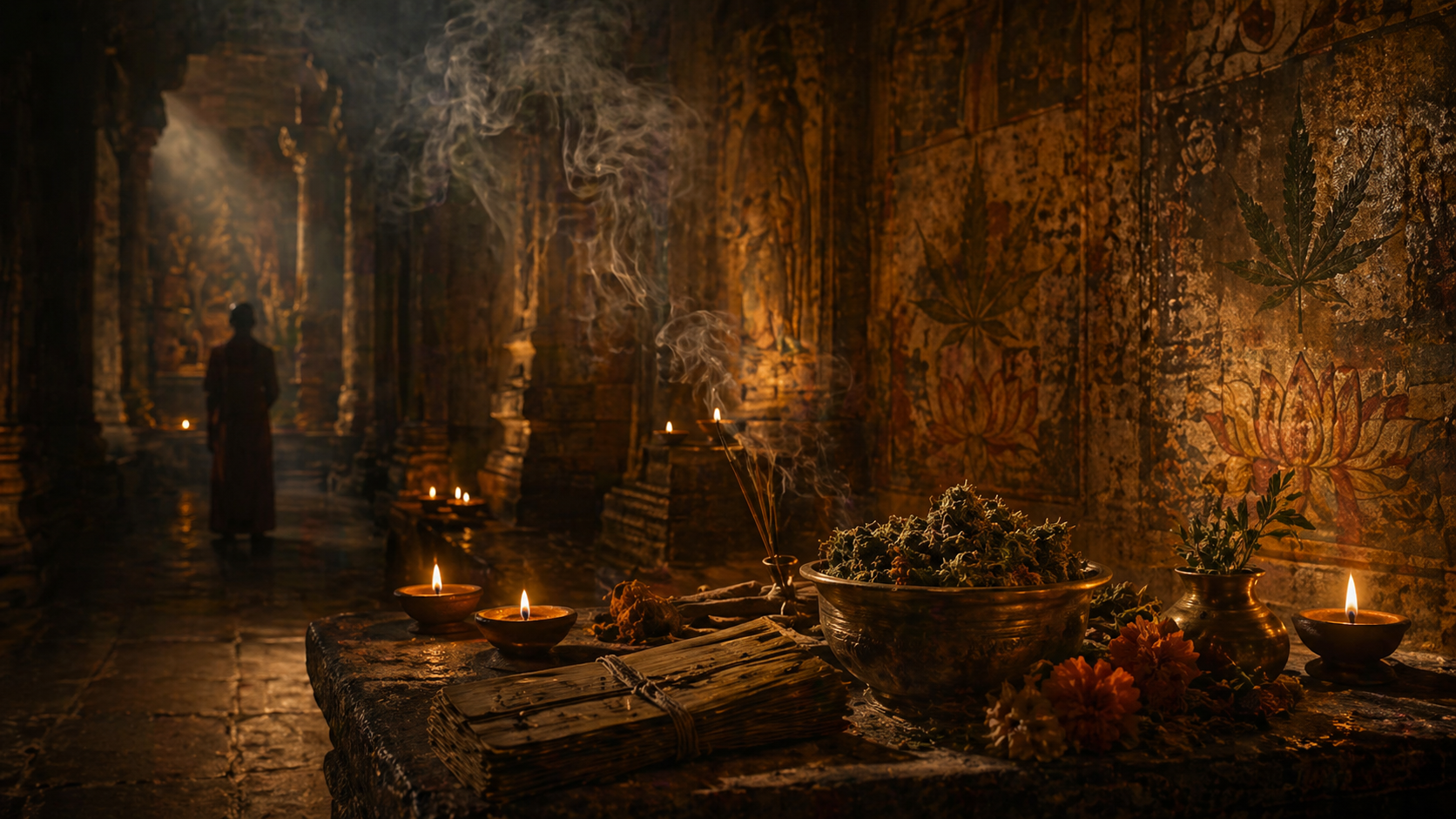
Cannabis was widely available, often legal or at least openly tolerated, and very cheap along nearly the entire route. In Afghanistan, [Cannabis Now reported in October 2024](https://cannabisnow.com/a-glimpse-into-afghanistans-traditional-cannabis-culture/) on Mazar-i-Sharif's continuing tradition — locals still gather in chillum khanas, share a hookah-style chillum for a small fee, and visit the shrine of Baba Ku Mastan where caretakers light a chillum with hashish and recite a centuries-old blessing.

Per the [Afghanistan Analysts Network's cultural history of cannabis](https://www.afghanistan-analysts.org/en/reports/context-culture/the-myth-of-afghan-black-a-cultural-history-of-cannabis-cultivation-and-hashish-production-in-afghanistan/), the first written record of "hashish from Cannabis Indica forma afghanica" produced in northern Afghanistan dates from 1965 — meaning the Hippie Trail era almost exactly coincides with the global emergence of what we now call Afghani genetics. In 1973, Afghan King Zahir Shah outlawed cannabis production, backed by 47 million dollars in U.S. funding, but enforcement was spotty enough that Afghan hash continued to flow west.
The Lebanese contribution came from the Bekaa Valley, which [Canatura's traditional-hashish overview](https://www.canatura.com/a/traditional-types-of-hashish-lebanon-afghanistan-morocco-ketama-and-pakistan-test) documents as one of the world's largest hash exporters in the 1960s. Nepal contributed Manali charas — hand-rubbed resin from wild plants — and Kashmir contributed its own pressed varieties. Different geographies, different climates, different techniques, all flowing along the same road.
Did The Trail Actually Change Cannabis In The West?
Yes — and the change was structural, not aesthetic. Per [Alchimia Grow Shop's cultural history](https://www.alchimiaweb.com/blogen/origins-evolution-moroccan-hashish/) and [Herbal Dispatch's reporting on Moroccan hash](https://herbaldispatch.com/blogs/news/from-morocco-to-the-world-the-evolution-of-moroccan-hash), Western travelers who had learned dry-sift hashish technique in Lebanon and Afghanistan literally taught Moroccan farmers how to refine their cannabis into pressed hash for export. That transfer, in the 1960s and early 1970s, is the reason "Moroccan hash" became a global product. Before the trail, only small pieces of Lebanese hash existed in Morocco. After the trail, Morocco was on its way to becoming the largest hashish producer on Earth.
The genetics traveled too. Per [Veriheal's cultural retrospective on the trail](https://www.veriheal.com/blog/cannabis-and-the-mystical-tale-of-the-hippie-trail/), the legendary modern landrace strains — Afghani, Hindu Kush, Nepalese, Chitral, Manali — are direct descendants of seeds brought back by travelers along the route. Every modern indica-leaning strain in the West, every Kush in a dispensary jar, traces some part of its lineage to a seed that crossed the Hippie Trail in someone's pocket in the 1960s or 1970s. Our Saturday Grow blog [Living Soil 101](https://www.weedcoinog.com/living-soil-101-why-top-shelf-cannabis-starts-in-the-dirt) and our Friday Craft post on [Live Resin vs Live Rosin](https://www.weedcoinog.com/live-resin-vs-live-rosin-craft-cannabis-concentrates) both rest on a foundation of genetic and technical knowledge that the trail helped move.
How Did The Trail End?
The trail did not fade — it slammed shut. Per the Wikipedia overland-trail entry and corroborated by [Adventures in Wonderland's first-person Marrakesh Express recollection](https://alisonanddon.com/2024/08/17/the-marrakesh-express-morocco-africa-overland-1980/), 1979 was the year the road closed. The Iranian Revolution made Iran impassable to Western travelers in February 1979. The Soviet invasion of Afghanistan in December 1979 finished it. The Lebanese Civil War, which had been going since 1975, sealed the southern alternative.
Pressure had been mounting earlier. Nixon's drug war reached Nepal — under U.S. pressure, the Nepalese government enacted the Narcotic Drugs (Control) Act in 1976, banning cannabis trade and farming and shutting down the legal hash shops on Freak Street. Locals between Kabul and Peshawar, per the same Wikipedia source, had started turning hostile to the constant flow of unkempt Western travelers drawn to the region's famous opium and wild cannabis. By 1980, when the road from Marrakesh to Marrakesh was the only "hippie trail" left, the original overland was already a memory.
Many of the cannabis cities along the route are now back on the map for different reasons. Some travelers have done partial versions of the route as recently as 2010, going Iran-northern-Pakistan because Afghanistan is too dangerous. Goa, Kathmandu, Marrakesh, Istanbul are tourist economies again. But the specific magic of an open overland road from London to Kathmandu, where cannabis was tolerated end-to-end and a stranger in a teahouse in Herat would offer you a bowl as a courtesy — that road is closed.
What Did The Trail Leave Behind?
Three things, all of them still inside the modern cannabis conversation.
First, genetics. Every Kush, every Afghani, every modern indica owes part of its DNA to a seed that came back in a backpack between roughly 1960 and 1979.
Second, technique. Dry-sift hashish in the West is a Hippie Trail import. The whole solventless lineage — bubble hash, ice water extraction, hash rosin — is a technical descendant of the dry-sift methods Western travelers learned in Lebanon and Afghanistan. We will pick that thread up next Friday in the Craft territory.
Third, voice. The first generation of Western cannabis writers, photographers, growers and chemists almost all walked some piece of the trail. The vocabulary they brought back — head, freak, charas, chillum, kif — is still the vocabulary of the culture. When a Mendocino grower says "indoor builds a number, outdoor builds a profile," they are speaking a language seeded in places like Mazar-i-Sharif and the Bekaa Valley fifty years earlier.
The road is closed. The culture it carried is still moving.
CONNECT WITH WEEDCOIN
Read the full post: https://www.weedcoinog.com/hashish-trail-cannabis-history-hippie-overland-route
Website: https://www.weedcoinog.com
Follow us on X: https://x.com/weedcoinog
Telegram: https://t.me/weedcoinogchannel
Chat With Wiz (GPT): https://bit.ly/ChatWithWeedcoin
Contract Address: 21nnfR4TkbZNLwvRrqEseAbz7P3kxKjaV7KuboLJpump
Like bitcoin but way higher 🌿