Cannabis and Consciousness: 5,000 Years of Sacred Ritual
From Scythian graves to Hindu temples, cannabis as sacrament.
Long before cannabis became a market, a movement, or a meme, it was a sacrament. Before the dispensary jar, before the eighth and the pre-roll, before any government ever bothered to schedule a plant, people on every inhabited continent were already using cannabis to talk to their gods, to bury their dead, to heal their sick, and to find the edge of their own minds. The plant has been with us for at least five thousand years, and almost all of that time, it has been holy.
This is the Roots territory. We are not chasing today's news. We are standing back and looking at the long line. Where this plant came from. Who used it. Why they used it. What every culture that ever met it figured out about it. And what we lost when prohibition tried to erase that lineage in a single century.
The oldest evidence is colder than you would expect. In 2019, a team of archaeologists working at the Jirzankal Cemetery on the Pamir Plateau in western China published their findings in the journal Science Advances. Inside 2,500-year-old stone burials, they found wooden braziers with the unmistakable chemical signature of high-THC cannabis residue burned inside. The chemistry showed selective breeding, not wild plants. Someone had cultivated those plants specifically because they were potent. Someone had carried them up into a high-altitude grave and lit them on purpose, in a place built only for the dead. The researchers' conclusion was straightforward. This was ritual. This was a ceremony around the dead, and cannabis smoke was the medium that carried it.
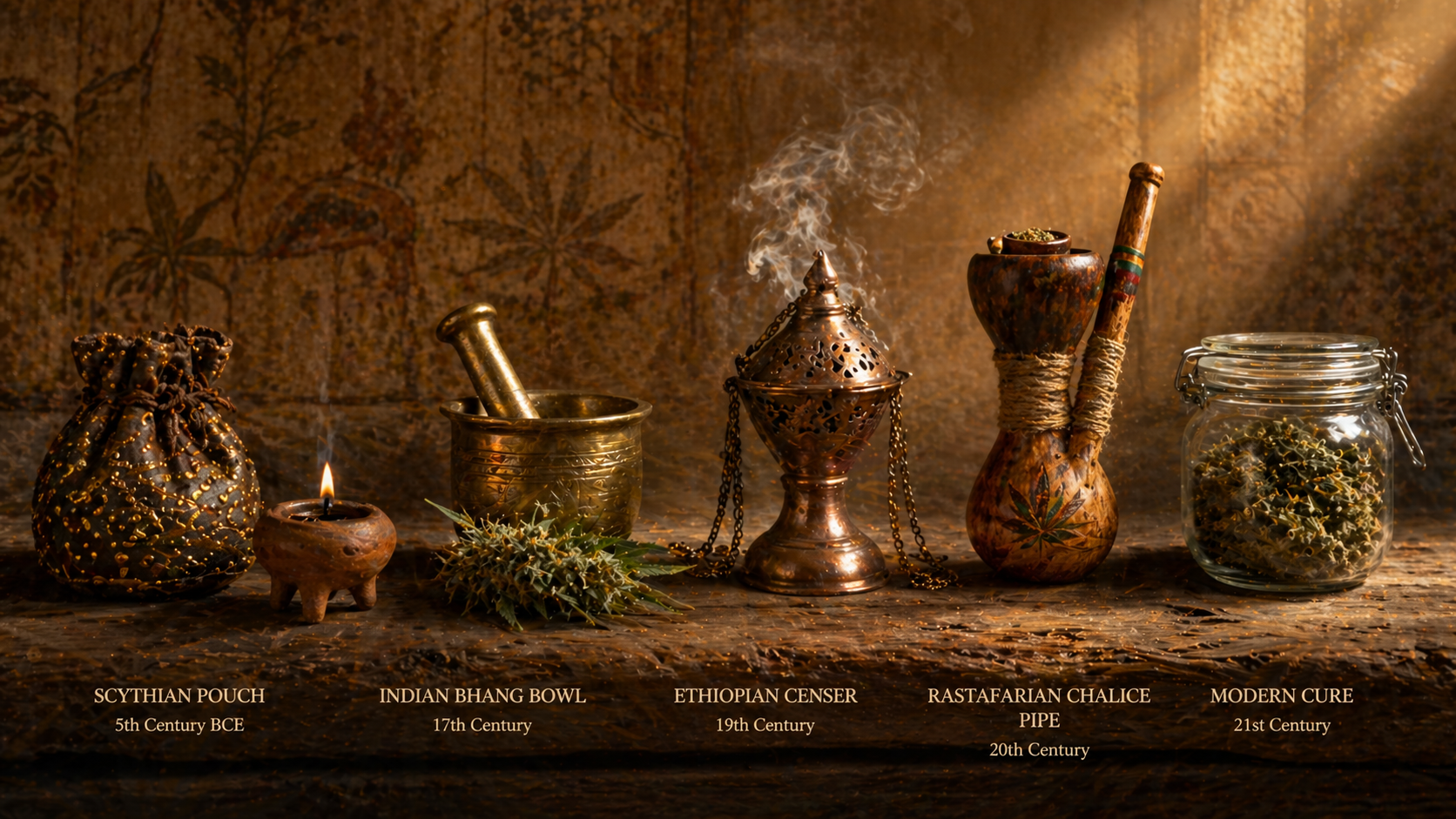
Move west and the story keeps repeating. The Scythians, the nomadic horse archers who ranged across Central Asia from roughly 900 BCE to 200 CE, were buried with leather pouches of cannabis seed and small portable braziers. Herodotus, writing in the 5th century BCE, described Scythian funerals where mourners crawled into small tents, threw cannabis on hot stones, and "howled with pleasure" inside the smoke. He thought it was strange. They thought it was how you said goodbye to a person. Excavations at Pazyryk in the Altai Mountains, where frozen ground preserved Scythian tombs almost intact, have turned up exactly the equipment Herodotus described, two and a half thousand years after he wrote about it.
Move further south and you reach the Indian subcontinent. In Hindu tradition, cannabis is bhang, and bhang is older than written history. The Atharva Veda, one of the four foundational texts of Hindu literature, dating to roughly 1,500 BCE, names cannabis as one of the five sacred plants. Lord Shiva is the god of bhang. To this day, in cities like Varanasi and Pushkar, religious pilgrims drink bhang lassi during the festival of Holi and during Maha Shivaratri, the night dedicated to Shiva, completely openly, completely legally, because the practice is older than the country and has never been separated from the religion. Hindu Sadhus, the wandering ascetics, smoke chillums of cannabis as part of their meditation. They will tell you the smoke is not the point. The point is what the smoke quiets in your head so you can hear something else.
Africa has its own deep lineage. Cannabis arrived in eastern and southern Africa at least a thousand years ago, possibly earlier through Indian Ocean trade. The Kafa people of southern Ethiopia have used cannabis ceremonially for centuries. Excavations near Lalibela have turned up clay smoking pipes with cannabis residue dated to the 13th and 14th centuries CE, predating European contact by hundreds of years. In southern Africa, the Khoisan peoples called it dagga and used it both medicinally and ritually. The Bashilenge of the Congo basin built whole religious societies around cannabis, calling themselves the Bena Riamba, the sons of hemp, and using the plant as a marker of peace and brotherhood between formerly hostile tribes.
In the Caribbean, Rastafari emerged in 1930s Jamaica drawing directly on this older African and Indian lineage. To Rastas, ganja is not a recreational substance. It is the holy herb of the biblical "tree of life," used in reasoning sessions and in Nyabinghi ceremonies, smoked in chalices and chillums brought across the world by indentured Indian laborers in the 19th century who had brought their bhang traditions with them. The reggae soundtrack we associate with Rasta culture is downstream of this. The herb came first.
The thread connecting every one of these traditions is not intoxication. It is attention. Every culture that took cannabis seriously took it seriously because the plant slows the mind down enough to notice things that are normally drowned out. A grieving Scythian could finally cry. A Hindu Sadhu could sit in stillness for hours. A Rasta in reasoning could hear what the brother across the room was actually saying. A Kafa elder could sit with a sick patient and pay full attention to what the body was telling them. The plant did not create the practice. The practice was already there. The plant just made it easier to enter.
Cannabis Benefits: Why ancient practice matches modern science
The wellness case for cannabis as a contemplative tool is not just folklore. Modern research is starting to map what those ancient cultures already knew, and the overlap is striking.
First, focused attention and present-moment awareness. A 2021 review in the Journal of Cannabis Research pulled together decades of work on cannabis and meditation, finding that low-to-moderate doses can enhance interoceptive awareness, the ability to notice what is happening in your own body. That is exactly the state every contemplative tradition is trying to cultivate. Researchers at the University of Washington's Center for the Science of Psychedelics have flagged cannabis as part of a broader category of "set and setting" plants whose therapeutic effect is mediated more by mindset and ritual context than by raw chemistry.
Second, anxiety reduction in low doses. Multiple studies, including a 2017 University of Illinois study published in Drug and Alcohol Dependence, have shown a dose-dependent biphasic effect on stress: low doses reduce subjective anxiety, higher doses increase it. The Sadhu smoking a small chillum and the Scythian throwing seeds on hot stones for a tent full of mourners were both, intuitively, dose-aware. The dose was small. The setting was sacred. The point was not to get blasted.
Third, grief processing and end-of-life care. Modern hospice and palliative care programs are increasingly integrating cannabis into pain management for terminal patients, with peer-reviewed support including a 2019 study in BMC Palliative Care showing improved quality-of-life scores. This is the modern echo of a Scythian funeral or a wake held with the herb burning. Every culture that buried its dead with cannabis understood that grief is also a body experience and that the plant could help the body get through it.
The lineage is real. The science is starting to show why.
Where Weedcoin fits
Weedcoin is a culture-first project. Culture has roots, and the deepest root of cannabis culture is not legalization, not commerce, not even agriculture. It is ritual. It is people across five thousand years of recorded history sitting together with this plant and trying to understand themselves better.
We are not asking anyone to be religious about cannabis. We are asking people to remember that the modern dispensary is the last few feet of a road that runs back through Rastafari, through Indian temples, through African villages, through Scythian graves, through Pamir cemeteries lit by braziers in the dark. The plant has been a teacher far longer than it has been a commodity. The community we are building only makes sense if it remembers that.
So today, on a Sunday, take a beat. Whatever your relationship with the plant is, sit with it for a minute. Notice what you notice. The Sadhu sitting in Varanasi tonight is doing the same thing the Scythian elder did 2,500 years ago. You are part of that line.
The renaissance is not just outdoor cannabis or craft genetics. It is also the slow remembering of why people picked up this plant in the first place.
Stay connected with the Weedcoin community:
Website: https://www.weedcoinog.com
Follow us on X: https://x.com/weedcoinog
Chat With Wiz (GPT): https://bit.ly/ChatWithWeedcoin
Contract Address: 21nnfR4TkbZNLwvRrqEseAbz7P3kxKjaV7KuboLJpump
Like bitcoin but way higher