
Hemp Goes Hardware: Cars, Concrete, and Packaging in 2026
Why Is Hemp Showing Up in Cars, Walls, and Cleaning Bottles?
Because hemp is finally being treated as a hardware crop, not just a textile or wellness ingredient. In 2026, the same plant that gets dismissed in pop culture is quietly going into walls, dashboards, insulation, and bottles. It is cheaper than people expect, lower carbon than the alternatives, and the supply chain is catching up fast. The U.S. and Europe industrial hemp construction materials market alone is sized at USD 2.62 billion this year and projected to hit USD 6.34 billion by 2033, growing at a 13.4% CAGR.
That is not a wellness story. That is hardware.
What Is Hempcrete and Why Is It Eating Concrete's Lunch?
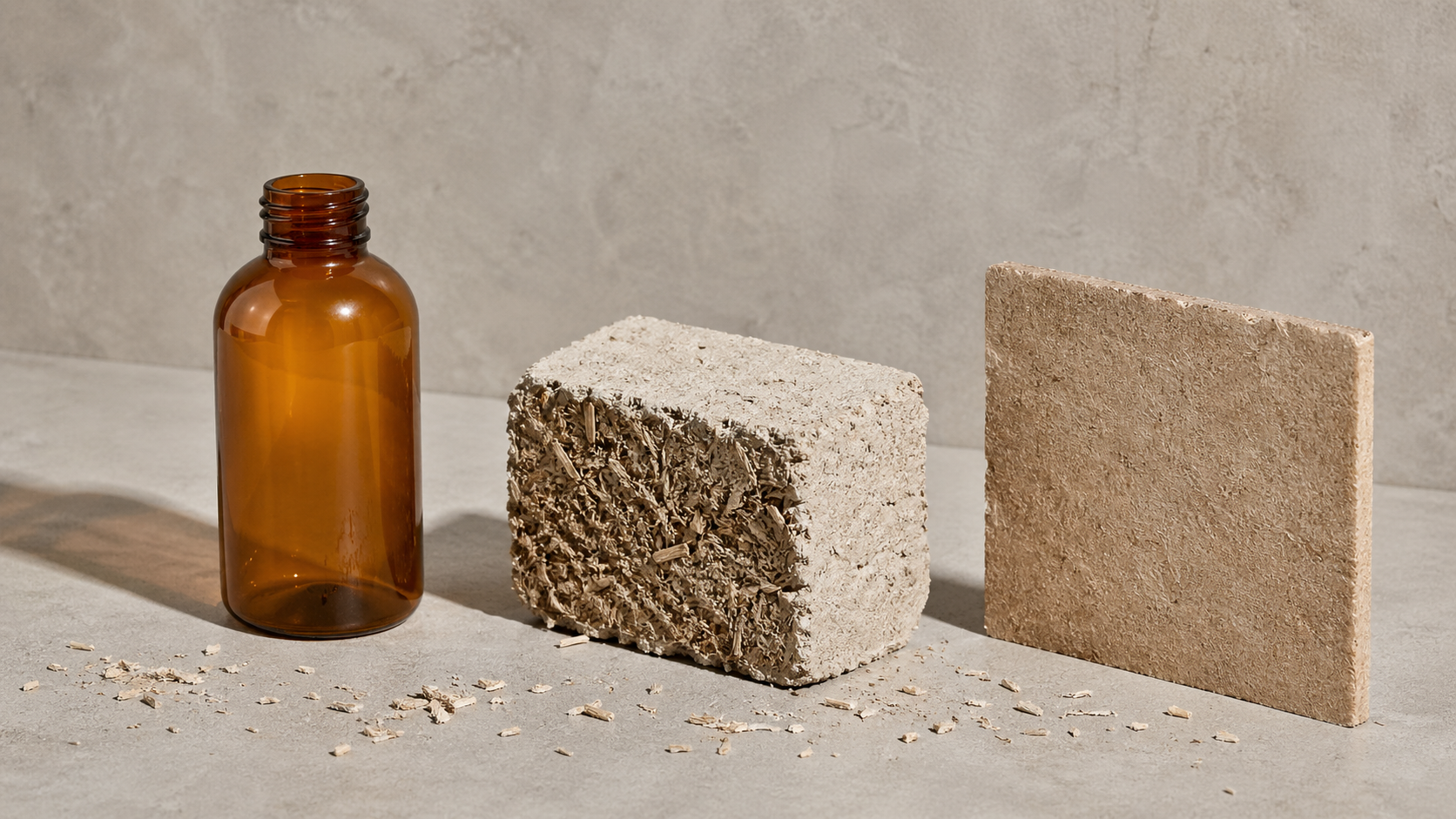
Hempcrete is a bio-composite made from hemp hurd, which is the woody inner core of the stalk, mixed with a lime-based binder. It is light, breathable, fire-resistant, and it actually pulls carbon out of the air as it cures. Coherent Market Insights projects hempcrete will hold 55.7% of the U.S. and Europe industrial hemp construction materials market in 2026, the dominant segment.
The economics matter. Hemp-lime blocks fit together fast — fewer workers, fewer days, less waste — and the building envelope segment using hemp materials is projected at roughly 35% of that 2026 market because energy codes keep getting stricter. France's RE2020 environmental regulation, which has been in force since 2022, explicitly promotes bio-based materials in new construction, and hemp showed up in housing projects in Nouvelle-Aquitaine and Occitanie before the policy was even fully phased in. Germany and the Netherlands are running their own version of the same playbook. Concrete is fighting a fight it is going to lose by inches over the next decade.
Did Henry Ford Really Build a Car Out of Hemp?
Yes. In 1941, Henry Ford built and demonstrated a prototype car body made from agricultural plastic — hemp was one of the fibers in the mix, alongside wheat straw and sisal, set in a soybean resin. He famously took an axe to the trunk lid for newsreels to show it would not dent. The car never went into production because petroleum-based plastics were cheaper to scale, but the engineering was real and the footage exists.
Eighty-five years later, the auto industry is circling back. European automakers have been quietly using hemp-fiber composites in interior door panels, parcel shelves, and trunk liners for years because the parts are lighter than fiberglass at similar strength. Lighter cars use less fuel, and lighter EVs use less battery to move the same distance. The hemp piece of an EV is not the headline, but it is exactly the kind of unglamorous weight savings that compounds across millions of vehicles.
How Is Hemp Replacing Plastic in Packaging?
Through biocomposites, and the science just got real. A study published April 25, 2026, in the Journal of Bioresources and Bioproducts (DOI 10.1016/j.jobab.2026.100264) showed hemp hurd microfiber blended with PLA boosted tensile strength of packaging films by about 20%, and hemp-blended mulch films jumped 33% in strength versus reference materials. Optimized formulations cut up to 4.25 kg of CO2 per kg of mulch film over their life cycle.
In Canada, Saskatchewan Polytechnic and EnviroWay Detergent Manufacturing are turning prairie flax and hemp into bottle-grade biodegradable plastic for cleaning products, backed by USD 250,000 from the Sustainable Canadian Agricultural Partnership Agriculture Development Fund and another USD 7,000 from the National Research Council of Canada Industrial Research Assistance Program. The pitch is simple — biodegradable cleaning bottles that do not outlast the product inside them.
This is the part of the story most cannabis media skips. Hemp hurd is the byproduct that used to get burned. Now it is structural fiber for packaging, mulch film, and a chunk of a 13.4% CAGR market.
Why Does This Matter for the Wider Cannabis Conversation?
Because the industrial hemp story keeps getting pulled back into the prohibition fight. Reefer Madness 1936, which we covered yesterday, criminalized the entire plant. The 1937 Marihuana Tax Act killed the U.S. hemp industry along with marijuana. The 2018 Farm Bill split them legally again at 0.3% THC. Schedule III, which moved state-licensed medical cannabis on April 22, 2026, did not touch industrial hemp at all. Hemp has been legal as a crop in the U.S. for seven years now, and the hardware applications are finally catching up to the biology.
Schedule III Is Here, the Justice blog from earlier this week, was about who gets prosecuted. This one is about what gets built. Different conversations, same plant, different ends of the supply chain.
Where Is the Hardware Going Next?
A few honest signals to watch:
- Modular hempcrete panels for prefabricated housing are the leading edge in Europe right now, and U.S. firms like Hempitecture in Idaho are scaling HempWool insulation to meet U.S. building codes.
- Hemp-fiber dashboards and door panels are quietly already in production in Europe and will keep spreading as automakers chase weight reduction in EVs.
- Hemp bioplastics are early but the funding is real and the LCA numbers are starting to favor them.
The bottleneck is not the plant. It is processing capacity, certification, and the boring infrastructure of supply chains. None of that is glamorous. All of it is happening.
Hemp is not the future. It is already in the wall.
What Should I Actually Take Away From This?
Three things, kept simple. First, hempcrete is not a hippie experiment anymore — it is a real product line with real building code traction in Europe and growing momentum in U.S. states like Idaho, Colorado, and Kentucky. Second, hemp in cars is back, quiet but steady, and EV weight pressure is going to keep pulling more hemp fiber into automotive interiors over the next decade. Third, hemp bioplastics finally have peer-reviewed strength data behind them, which is the part packaging buyers were waiting on.
The people who keep saying hemp is just rope and seed oil are reading 1995 talking points in 2026. The actual industry is industrial. The actual question is how fast the processing and certification side scales to match what the crop can already deliver. That is the part worth watching.
Stay loud. Stay informed. Stay Weedcoin.
X: https://x.com/weedcoinog
Site: https://www.weedcoinog.com
Telegram: https://t.me/weedcoinogchannel
Chat With Wiz (GPT): https://bit.ly/ChatWithWeedcoin
Contract: 21nnfR4TkbZNLwvRrqEseAbz7P3kxKjaV7KuboLJpump
Like bitcoin but way higher