Cannabis Is Saving Lives in the Opioid Crisis -- and the Research Proves It
The research says cannabis is one of the most powerful tools for fighting it.
Let's rise above the stigma.
The opioid crisis is not an abstract statistic. It is the mother whose son stopped calling. The coworker who did not come back after a long weekend. The neighbor with the paramedics outside at 2 AM. It has taken more than 600,000 American lives since 1999. It is still happening.
What if one of the most stigmatized plants in America was also one of the most powerful tools for fighting it?
The research is not fringe. It is not anecdote. It is peer-reviewed science from Johns Hopkins University, Boston University School of Public Health, and the National Academies of Sciences, Engineering, and Medicine. And it says cannabis meaningfully reduces opioid use, eases withdrawal symptoms, and may help keep people alive while they try to get clean.
This is what rising above the stigma looks like.
What the Research Actually Says
In a study published in Drug and Alcohol Dependence by Boston University School of Public Health researchers, US states that legalized marijuana for both medical and adult recreational use saw a 9-to-11-percentage-point decline in daily opioid use among people who inject drugs, compared to states that only legalized medical cannabis. This is a population that has historically been hardest to reach with conventional treatment. A double-digit percentage point reduction in daily opioid use is not a minor finding.
A study from Johns Hopkins University tracked 125 people using cannabis to manage opioid withdrawal symptoms. Of those:
- Over 70 percent said it helped improve symptoms overall
- 76.2 percent said it reduced anxiety during withdrawal
- 54.1 percent said it reduced tremors
- 48.4 percent said it improved sleep
- 45.9 percent said it decreased joint, bone, and muscle aches
- 45.1 percent said it decreased restlessness
- 38.5 percent said it reduced nausea
- 37.7 percent said it reduced cravings for opioids
The study authors concluded: "These results show that cannabis may improve opioid withdrawal symptoms and that the size of the effect is clinically meaningful."
One of the primary reasons people relapse after beginning treatment for opioid use disorder is the severity of withdrawal. The symptoms -- anxiety, tremors, bone pain, nausea, restlessness, insomnia, and overwhelming cravings -- are the reason people go back to the drug they are trying to quit. If cannabis reliably addresses the majority of those symptoms for the majority of people trying to quit, it is not a recreational indulgence. It is a harm reduction tool.
The National Academies of Sciences confirms: when given access to cannabis, individuals currently using opioids for chronic pain decrease their opioid use by 40 to 60 percent. They report fewer side effects with cannabis than with opioid medications. They experience improved cognitive function and better quality of life.
The Pharmaceutical Tariff Angle
Here is a dimension to this conversation that has not gotten enough attention: Trump's recent executive order imposing 100-percent tariffs on branded and patented pharmaceuticals from companies that have not reached pricing agreements with the administration could dramatically change the cost calculus for conventional medications.
If FDA-approved opioid medications, addiction treatment drugs like buprenorphine and naltrexone, and other pharmaceutical options become significantly more expensive due to import tariffs, plant-based alternatives that are domestically grown and already accessible in legal markets become more economically relevant, not less.
The administration's stated goal is to lower drug prices and increase domestic manufacturing. Cannabis fits that frame almost perfectly -- it is grown in the United States, regulated by state markets, and available without pharmaceutical supply chains. Whether that logic influences policy is unclear. But the tariff-driven pharmaceutical cost increase is a real variable in the access equation.
New Jersey Gets a Lifeline
In news that got buried under the tariff headlines: New Jersey Governor Sherrill signed S3945 on March 30. The bill extends the transition timeline for hemp products and intoxicating hemp beverages through November 2026, giving the industry additional months to comply, reformulate, and transition to a licensed model.
The April 13 restrictions still apply in modified form -- THC limits for beverages sold through ABC-licensed retailers still apply, and synthetic cannabinoids remain banned -- but the existential business cliff has been pushed to November. Retailers who were looking at going out of business in six days now have seven months.
The White House Cannabis Meeting
For the first time, federal agencies including the FDA and DOJ held a coordinated meeting specifically focused on cannabis and hemp enforcement. The tone, according to reporting from TDR Cannabis, has shifted from observation to action.
At the center of the discussion is the FDA's proposed CBD compliance policy -- covering testing standards, labeling requirements, and product safety -- which has been in White House OIRA review since March 13. But the broader conversation included intoxicating hemp-derived products like delta-8, which continue to operate outside regulated cannabis systems.
The meeting signals that the era of federal non-enforcement for hemp-derived THC products is ending. What replaces it -- a workable regulatory framework or a blanket crackdown -- will determine whether the legal hemp industry survives the coming year.
Cannabis in the Opioid Crisis: What Happens at the Human Level
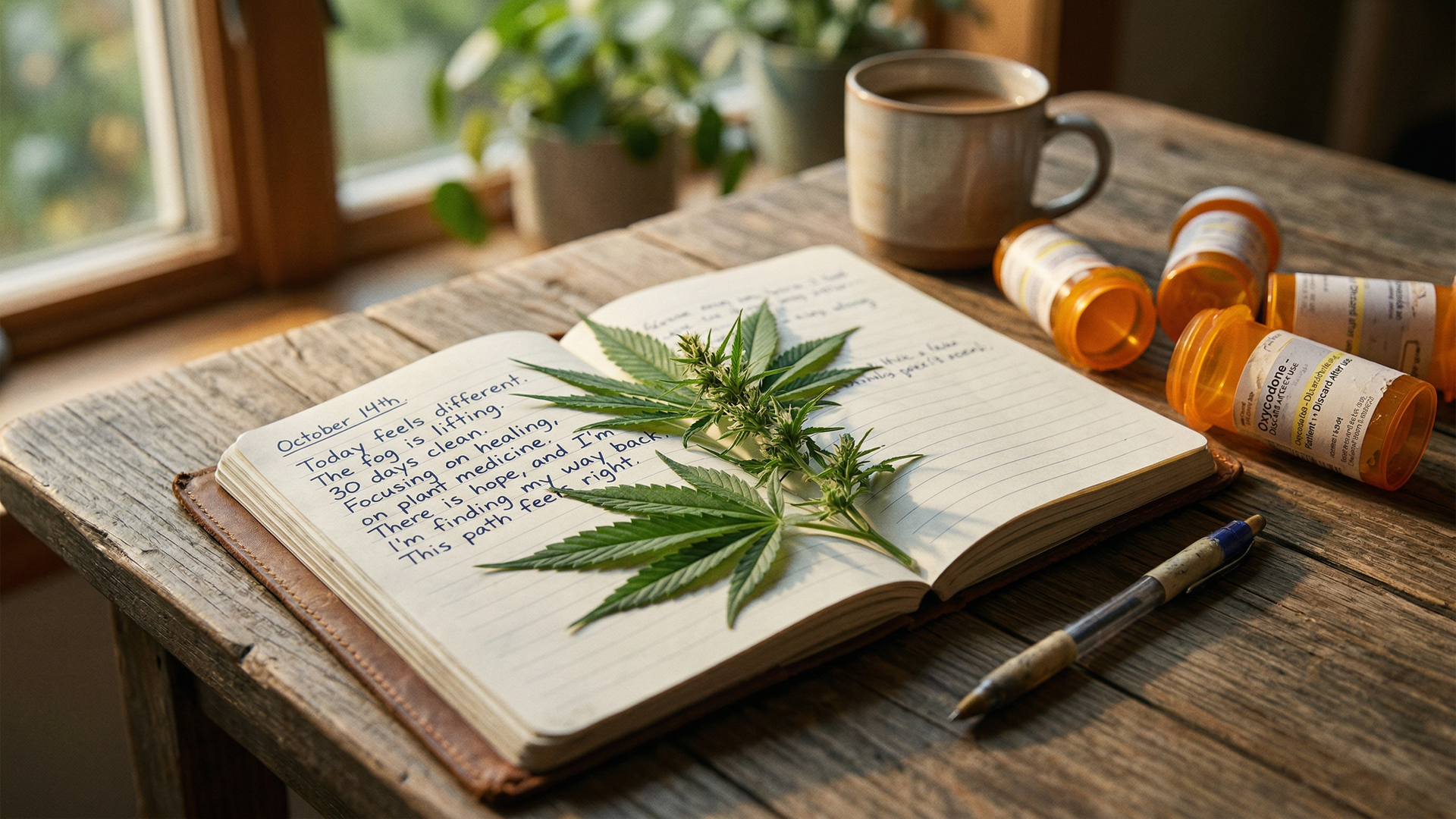
Beyond the statistics, it is worth understanding what cannabis-assisted opioid recovery actually looks like in practice.
A person trying to quit heroin or opioids faces what clinicians describe as one of the most physically and psychologically brutal withdrawal experiences in medicine. Unlike alcohol withdrawal, opioid withdrawal rarely kills directly -- but the misery is so severe that most people relapse not because they want to use, but because they cannot endure the symptoms.
The conventional treatment toolkit includes methadone, buprenorphine (Suboxone), and naltrexone. These medications are effective. They save lives. But they are also difficult to access, carry their own stigma, require clinical enrollment, and are not sufficient for every patient.
Cannabis enters the picture as an adjunct -- not a replacement for medication-assisted treatment, but a supplement that addresses the specific symptoms that drive relapse. Someone managing withdrawal with a combination of buprenorphine and cannabis who can sleep, whose anxiety is tolerable, whose bone pain is manageable, and whose cravings have diminished has a better chance of staying in treatment long enough for it to work.
The Johns Hopkins social media analysis found that in addiction recovery communities online, cannabis-related posts were about twice as common as in active opioid use communities. People in recovery were talking about cannabis as a tool for managing withdrawal symptoms -- in conjunction with anti-anxiety medications and other support, not as a standalone replacement.
The most common motivations cited: managing opioid withdrawal symptoms, particularly anxiety and gastrointestinal distress.
This is what Cesar meant. This is what rising above the stigma means. Not getting high. Getting well.
Solana: Testing Support
SOL is trading in the $78-$82 range, testing the critical $75-$78 support zone that has historically served as a floor before major recovery cycles. TVL across the Solana ecosystem has fallen from $9 billion to approximately $5.5 billion since the Drift exploit, reflecting real capital leaving the network.
The $73 technical target is now a meaningful scenario if $75 fails on a daily close. Recovery requires reclaiming $86 first, then $93. Institutional SOL ETFs recorded their second consecutive week of net outflows.
The network's fundamental case -- $57 billion in monthly DEX volume, $650 billion in stablecoin transactions, Firedancer at 600K TPS, the Solana Developer Platform with institutional partners -- remains intact. But macro pressure and ecosystem confidence matter in the short term. Patience is required.
Thirteen days to 4/20.
The research on cannabis and opioids is not permission to dismiss addiction treatment or replace proven therapies. It is permission to expand the conversation -- to include cannabis as a legitimate harm reduction tool, to fund more research, to remove the legal barriers that prevent addiction specialists from even discussing it with patients, and to recognize that fighting the stigma around cannabis is inseparable from fighting the stigma around addiction itself.
That is what this community is for. That is why we show up every day.
Stay connected with the Weedcoin OG community:
Website: https://www.weedcoinog.com
Follow us on X: https://x.com/weedcoinog
Chat With Wiz (GPT): https://bit.ly/ChatWithWeedcoin
Contract Address: 21nnfR4TkbZNLwvRrqEseAbz7P3kxKjaV7KuboLJpump
Like bitcoin but way higher