
Medicare CBD Survives Court, Tariffs Hit Cannabis, and NJ Has 10 Days Left
The judge said no to the injunction. The tariffs said yes to higher prices. And New Jersey has 10 days to clear its shelves.
The Medicare CBD pilot program survived its first legal test. A federal judge denied the emergency injunction filed by Smart Approaches to Marijuana and allied prohibitionist groups, allowing the Centers for Medicare and Medicaid Services to move forward with covering hemp-derived CBD and THC products for seniors. Five Accountable Care Organizations have already submitted implementation plans.
The lawsuit is not over -- a hearing on the full preliminary injunction is scheduled for April 20. But for now, the program stands. And the date of that hearing is not lost on anyone in the cannabis community.
In other news that hits wallets harder than policy papers: Trump's tariff regime is driving cannabis costs through the roof. And New Jersey has 10 days until its hemp market effectively ends.
Medicare CBD: The Judge Said No to the Block
CMS Administrator Dr. Mehmet Oz confirmed the launch of the pilot program earlier this week, revealing that five ACOs have already submitted implementation plans. The program allows participating physicians to recommend hemp-derived CBD products -- including products containing up to 3 milligrams of THC per serving -- to Medicare beneficiaries, with coverage of up to $500 per patient per year.
Smart Approaches to Marijuana's lawsuit argued that CMS was bypassing the FDA drug approval process by covering products that have not undergone formal clinical validation. The judge was not persuaded, at least not enough to block the program before a full hearing.
That hearing is scheduled for April 20. The symbolism is impossible to miss. The same day the Army's new marijuana waiver policy takes effect, a federal court will decide whether seniors can keep accessing CBD through Medicare.
For patients, the ruling means the program continues while the legal fight plays out. For the industry, it is a signal that the courts are not automatically deferring to prohibitionist arguments -- even when the plaintiffs are well-funded and politically connected.
Meanwhile, David Heldreth of Panacea Plant Sciences participated in the White House Office of Management and Budget's first meeting about the FDA's CBD enforcement policy. The framework that has been eight years in the making is now in its final review stage.
Tariffs Are Hitting Cannabis Hard
Here is a story that affects every cannabis consumer and operator in the country, and almost nobody is talking about it.
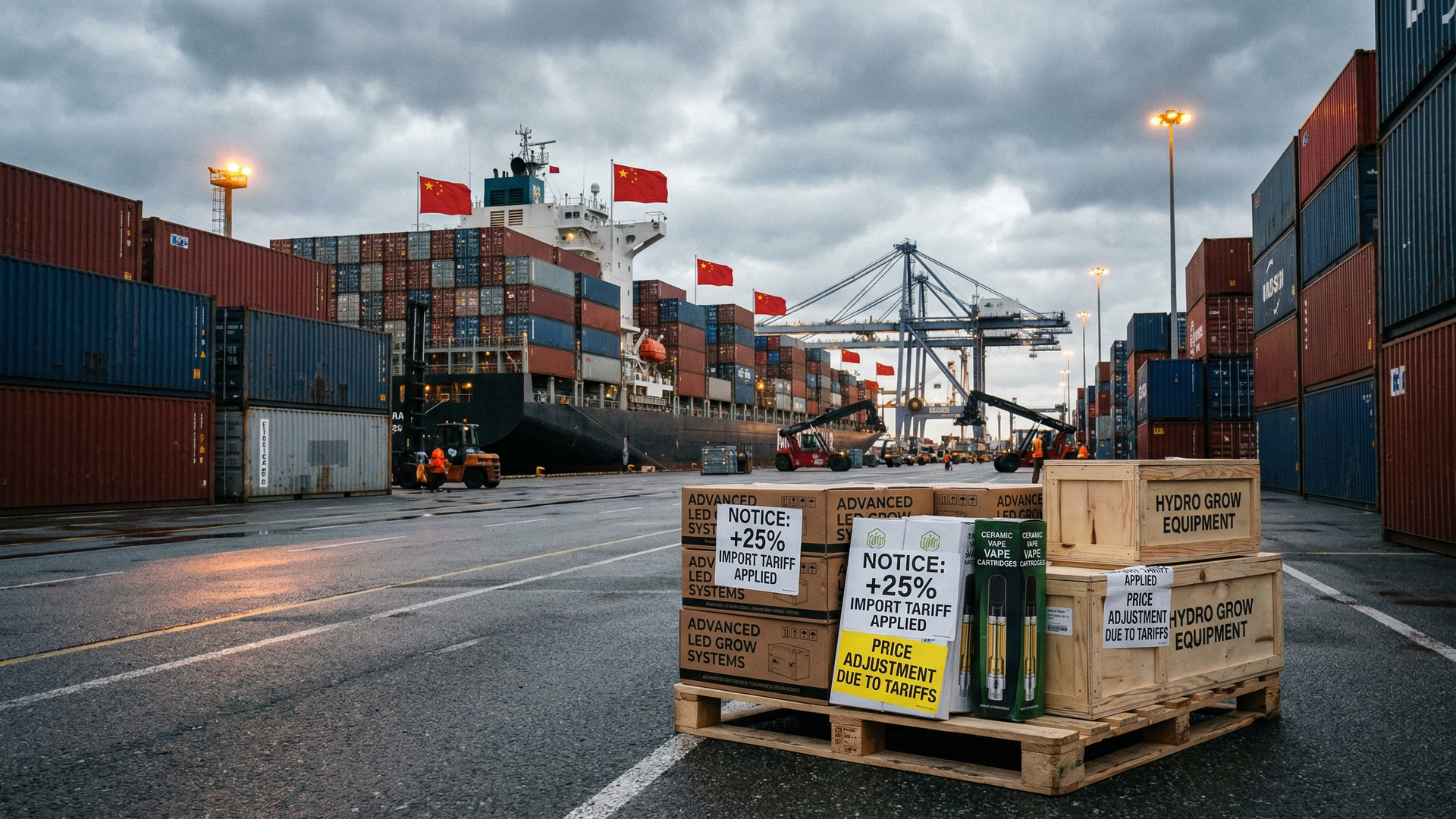
Trump's tariff regime has pushed total tariffs on Chinese imports to 54 percent. For the cannabis industry, which relies heavily on Chinese manufacturing for vape hardware, packaging materials, specialized glass, and cultivation equipment, the impact is immediate and severe.
One CEO reported that vape hardware tariffs from China now sit at 46 percent. Another noted that essential growing supplies like compost and peat, imported from Canada, face their own tariff increases. Companies are scrambling to relocate manufacturing to Malaysia, Indonesia, and other Southeast Asian countries -- but those nations face tariff rates of 24 to 32 percent themselves.
Cannabis products cannot be imported or exported due to federal law. But the raw materials, equipment, and packaging that make those products possible are deeply tied to global supply chains. When tariffs raise the cost of vape cartridges, grow lights, extraction equipment, and packaging, those costs flow straight to the consumer.
The result is predictable: higher prices push more consumers toward the illicit market, further squeezing the profit margins of legal operators who are already dealing with 280E tax burdens, state-by-state regulatory patchworks, and now state-level hemp bans.
For an industry that cannot deduct normal business expenses on its federal taxes, cannot access traditional banking, and now faces 54 percent tariffs on essential supplies from its largest manufacturing partner, the economic pressure is compounding.
New Jersey: 10 Days
The clock is ticking louder in New Jersey.
On April 13, the state's new hemp definitions take effect. Any product exceeding 0.3 percent total THC by dry weight or 0.4 milligrams total THC per container will be reclassified as cannabis and can only be sold through CRC-licensed dispensaries. Synthesized cannabinoids -- already prohibited from production since January 13 -- will officially cease to qualify as hemp.
A $3.75 per gallon excise tax kicks in on intoxicating hemp beverages. Potency caps become mandatory: 5mg THC per serving, 10mg per container for beverages. Only holders of ABC plenary wholesale or retail distribution licenses and CRC Class 5 cannabis retailers can sell them.
On November 13, the beverage exception closes entirely. Any intoxicating hemp beverage over 0.4mg total THC per container becomes cannabis.
Penalties include civil monetary fines per violation, license suspensions, product seizures, and potential referral to the Attorney General or law enforcement.
A bill (S3945) passed both chambers to potentially extend the timeline through November 2026, but it is waiting for the governor's signature.
Operators have 10 days to conduct SKU-level compliance audits, reformulate products, update labeling and COAs, prepare for excise tax implementation, confirm licensing for IHB sales, and retrain staff. The compliance checklist reads like a full business overhaul.
Cannabis and Crohn's Disease: What the Evidence Shows
Today's cannabis benefits section covers Crohn's disease and inflammatory bowel disease -- conditions that affect an estimated 3 million Americans and for which conventional treatment often falls short.
The landmark clinical trial by Naftali and colleagues -- the first placebo-controlled study of cannabis in IBD -- demonstrated that eight weeks of THC-rich cannabis caused a decrease in the Crohn's Disease Activity Index in 90 percent of patients without producing significant side effects. While the primary endpoint of full remission was not statistically achieved due to the small sample size (21 patients), the clinical improvement was substantial.
The mechanism involves the endocannabinoid system's extensive presence in the gastrointestinal tract. CB1 receptors in the enteric nervous system act as a brake against hyperstimulation caused by inflammatory mediators during IBD. CB2 receptors, which are differentially expressed in IBD tissue, play a key role in the ameliorating effect. THC activates both receptor types, reducing hypermotility -- which alleviates the chronic diarrhea that devastates quality of life for Crohn's patients.
A study of 76 IBD patients (51 with Crohn's, 25 with ulcerative colitis) treated with cannabis-based medicinal products showed improvements in IBD-specific quality of life scores at both 1 and 3 months. General quality of life, anxiety, and sleep quality also improved. Patients who had previously used cannabis showed greater improvement and fewer adverse events than cannabis-naive individuals.
An important caveat: while cannabis clearly improves symptoms and quality of life, there is limited evidence that it resolves the underlying intestinal inflammation. Heavy cannabis use has been associated with more severe GI disease and increased surgical risk in some studies. Cannabis cannot replace conventional IBD treatment -- but for patients who are refractory to standard therapies, it offers meaningful symptom relief.
Up to 27 percent of IBD patients are active cannabis users, primarily for abdominal pain, nausea, diarrhea, and appetite improvement. The gap between patient behavior and clinical guidance is narrowing as the evidence base grows.
Colorado and Missouri Make Moves
Two quick state updates worth tracking:
Colorado Governor Jared Polis signed a bill allowing terminally ill patients to use medical cannabis in healthcare facilities including hospitals. The bill passed with amendments making participation optional for care centers rather than mandatory -- which Polis criticized, though he signed it anyway.
The Missouri Senate approved a bill that bans intoxicating hemp products, protects marijuana consumers' privacy, and recognizes cannabis industry workers' right to unionize. Three very different provisions in one bill -- reflecting the complexity of cannabis policy at the state level.
Solana: Record Stablecoin Volume
Solana continues to lead all Layer 1 and Layer 2 networks in monthly DEX trading volume for the seventh consecutive month, with $57 billion in March 2026. Stablecoin transaction volume hit a record $650 billion in February -- nearly three times January's figure.
The Solana Developer Platform launched with Mastercard, Worldpay, and Western Union as early adopters. The platform includes modules for issuance, payments, and trading -- making it significantly easier for institutions to build financial products on Solana.
SOL trades around $83, holding the $80 support. The $86 20-day EMA is the key level to reclaim for short-term recovery.
Seventeen days to 4/20. Ten days until New Jersey. The Medicare pilot stands. The tariffs keep climbing. And the dominoes keep falling.
Stay connected with the Weedcoin OG community:
Website: https://www.weedcoinog.com
Follow us on X: https://x.com/weedcoinog
Chat With Wiz (GPT): https://bit.ly/ChatWithWeedcoin
Contract Address: 21nnfR4TkbZNLwvRrqEseAbz7P3kxKjaV7KuboLJpump
Like bitcoin but way higher