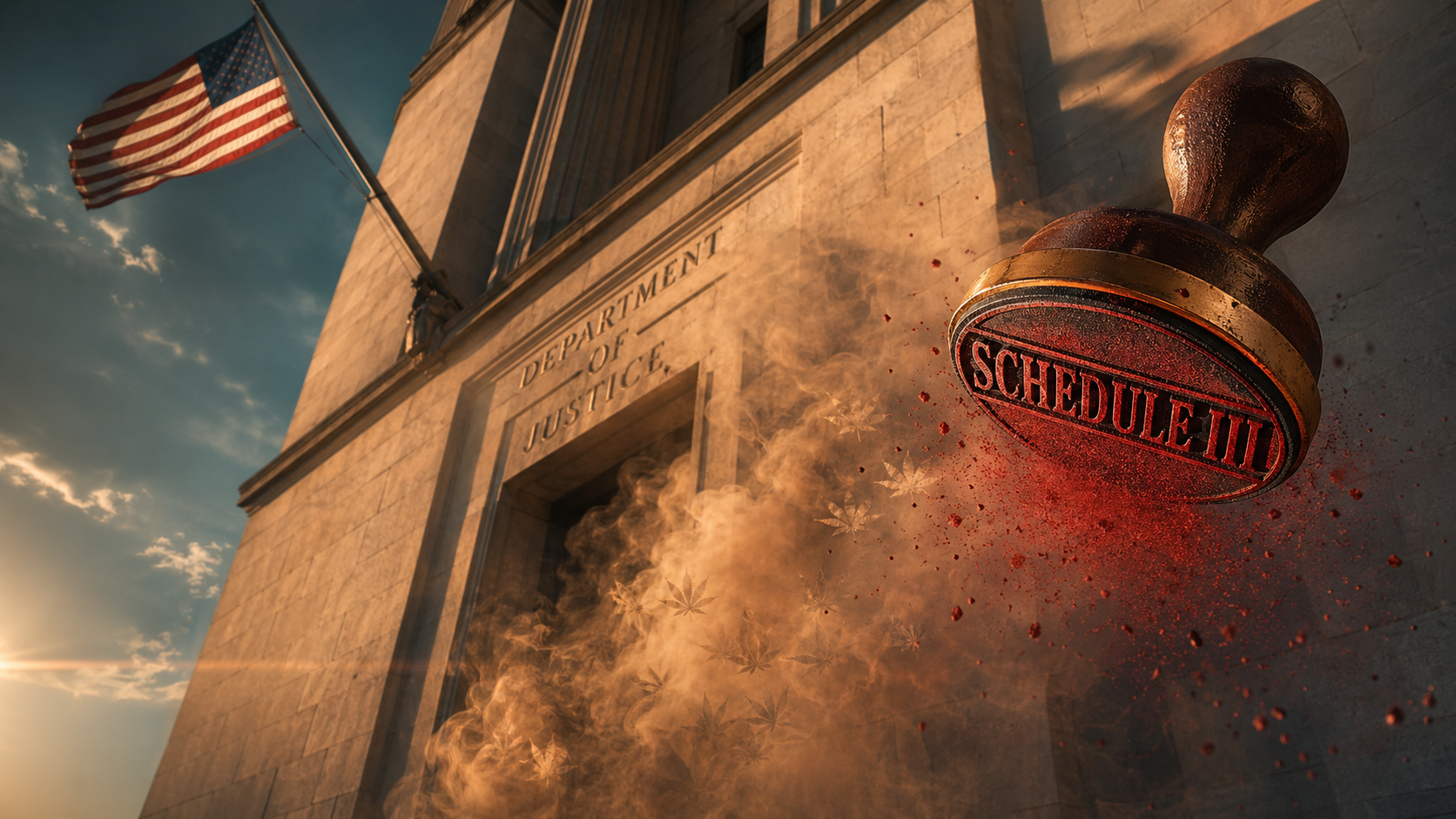
The 1937 Marihuana Tax Act -- How Two Pages of Lies Won
Less than two pages of debate. One dissenting witness. One lie.
On August 2, 1937, President Franklin D. Roosevelt signed the Marihuana Tax Act into law. The New York Times ran nine references to marijuana in the year and a half before the signing. The public barely knew the debate was happening. The House of Representatives spent less than two pages of debate before voting on the bill. It passed on a voice vote.
The single dissenting witness during the congressional hearings was the American Medical Association's legislative counsel, Dr. William Creighton Woodward, a physician and lawyer who had spent years drafting narcotic regulation legislation. He testified that no evidence existed for the claims the bill's supporters were making. His testimony was met with hostility and indifference. The chairman accused him of obstructionism. His medical opinion was dismissed in favor of a collection of tabloid clippings known as the Gore File.
After Woodward left the chamber, a Treasury Department representative named Fred Vinson stood up and told Congress that the AMA supported the bill. The transcript shows that the AMA's own witness had just explicitly opposed it. Nobody corrected the record. The vote was called.
Welcome to The Suppression Files. This is week one. This is where it started.
Who Was Harry Anslinger
To understand how a plant that had been in the U.S. Pharmacopoeia since 1850 became federally prohibited on August 2, 1937, you have to understand the man who wrote the bill.
Harry Jacob Anslinger was appointed the first commissioner of the Federal Bureau of Narcotics in 1930 at the age of thirty-eight. He was a career Prohibition enforcement officer who watched his agency's reason for existence collapse when the Twenty-first Amendment repealed alcohol prohibition in 1933. His bureau needed a new enemy. Anslinger found one in cannabis.
Early in his tenure, Anslinger was on record stating that cannabis use was no particular concern. He publicly called the idea that cannabis caused violence "an absurd fallacy." By 1935, his public position had flipped 180 degrees. Cannabis, he now claimed, turned users into murderers, rapists, and lunatics. What changed was not the plant. What changed was his agency's need to justify its continued existence and expanded budget.
Anslinger was also a virulent racist. His own writings, donated by him to Pennsylvania State University and now available as public archival material, contain explicit statements about cannabis users being disproportionately "Negroes, Hispanics, Filipinos, and entertainers." He testified to Congress that fifty percent of all violent crimes in the United States were committed by Spaniards, Mexican-Americans, and Greeks, and that marijuana was the direct cause. He had no data to support this. He had his Gore File.
The Gore File
The Gore File was Anslinger's primary evidence. It was a collection of newspaper clippings, mostly taken from William Randolph Hearst's chain of papers, describing horrific crimes that were attributed, often tenuously, to cannabis use. A man chopped his family apart with an axe. A young woman jumped out of a window. A teenager murdered his parents with a hatchet.
Scholars who later attempted to verify these stories found that virtually none of them held up. Some were completely fabricated. Others involved people who had used cannabis days or weeks before the crime, with no evidence of impairment. Several involved underlying mental illness that the stories attributed to cannabis use with no supporting evidence.
But in 1937, the Gore File was what Congress saw. Anslinger presented it as factual crime data. The committee accepted it. No one challenged the methodology. No one asked to cross-reference the police records. No one called the family members of the alleged victims.
This was the evidentiary foundation of the Marihuana Tax Act. A binder of tabloid clippings.
The Word "Marihuana"
Until Anslinger, the plant was called cannabis or Indian hemp in American medical, legal, and agricultural contexts. The 1850 U.S. Pharmacopoeia listed it as cannabis. Physicians prescribed cannabis tinctures for menstrual pain, migraines, insomnia, and appetite stimulation. Queen Victoria received cannabis tinctures from her personal physician, Sir J. Russell Reynolds, who called it "one of the most valuable medicines we possess."
Anslinger popularized the Spanish word marihuana specifically to racialize the plant. In his testimony and press releases, he consistently referred to marijuana users as Mexican and Black. The word itself was weaponized to separate the medicine that respectable Americans used from the drug that minorities were supposedly using to corrupt the nation.
Hearst's newspapers adopted the same language. Headlines stopped saying "cannabis" and started saying "marihuana." A 1936 film called Reefer Madness put the word on movie screens across the country. By the time the congressional hearings began, the public had been primed for months to associate the word with violence, insanity, and foreign contamination.
The word stuck. Nearly ninety years later, federal law still uses the spelling "marihuana" in official statutes. The racial origin of the name is documented. The choice to keep it is a choice.
The Economic Interests
The standard popular history names four conspirators: Hearst, the DuPont family, Andrew Mellon, and Anslinger. The full story is more complicated, but the economic motivations were real.
William Randolph Hearst owned forty-two newspapers at the peak of his influence. He had substantial interests in the timber and paper industries. The invention of the hemp decorticator in the mid-1930s suddenly made hemp paper economically competitive with wood pulp. Hearst's newspapers led the sensationalist coverage of cannabis crimes from 1934 onward. Whether this was pure yellow journalism or calculated economic warfare is debated. The timing is not.
The DuPont family had invested heavily in petrochemical-based synthetic fibers. Nylon was patented in 1938, one year after the Tax Act. DuPont's 1937 annual report to stockholders explicitly referenced "radical changes" coming from the "revenue raising power of government converted into an instrument for forcing acceptance of sudden new ideas of industrial and social reorganization." Read that sentence twice. The company anticipated the government creating markets for its new synthetic fibers through legislative action.
Andrew Mellon was the Secretary of the Treasury. He was also the uncle of Anslinger's wife. Mellon's bank, Mellon Bank, was the principal creditor of DuPont. The chain of financial interest ran from the Treasury Department, which housed the Federal Bureau of Narcotics, to the largest banking family in America, to the chemical company whose new product would compete with hemp fiber.
Skeptics argue that hemp cultivation in 1937 was only fourteen thousand acres nationwide, making it a minor economic threat. This is true. But the counterargument is that the decorticator had just made hemp economically viable at scale for the first time in decades, and the conspirators moved to kill the industry before it could grow. Both views can be true. The policy outcome killed American hemp regardless of motive.
Dr. Woodward's Testimony
On May 4, 1937, Dr. William Woodward of the American Medical Association sat before the House Ways and Means Committee. He had been instructed by the AMA Board of Trustees to protest the enactment of the bill.
His testimony was careful and precise. He stated that no evidence existed that medicinal cannabis use was causing addiction. He pointed out that cannabis preparations were used to a limited but legitimate extent in medicine. He argued that the bill as written would impose so many restrictions on physicians and pharmacists that it would effectively eliminate medicinal cannabis altogether. He proposed that if any federal regulation was needed, it should be added to the existing Harrison Narcotics Act rather than passed as a separate, inadequately considered law.
Woodward also noted the striking lack of cooperation the AMA had received from the Federal Bureau of Narcotics during the drafting process. The AMA had not been consulted. The medical profession had been bypassed.
The committee response was hostile. The chairman accused Woodward of obstructionism and bad faith. Woodward was dismissed. Less than two pages of debate followed. The vote was called. The Act passed.
Then Fred Vinson stood up and told Congress that the AMA supported the bill.
The transcript shows Woodward had just explicitly opposed it. Vinson's statement was a direct lie to the legislative body. No one caught it in the moment. The bill went to the Senate. The Senate made minor amendments. The House adopted those amendments as quickly as possible. The bill went to President Roosevelt's desk. On August 2, 1937, it became law.
The Cost of What Was Done
The Marihuana Tax Act did not technically ban cannabis. It imposed a one-dollar tax per ounce, required federal registration, and demanded tax stamps for every transaction. The tax was trivial. The registration requirements were not. Failure to comply was punished with fines up to two thousand dollars and imprisonment up to five years.
In practical effect, the Act killed medicinal cannabis within three years. The AMA could not organize pharmacists, physicians, and veterinarians to obtain tax stamps fast enough to maintain legitimate use. The American Pharmaceutical Association dropped cannabis from the United States Pharmacopoeia in 1942. A plant that had been in American medicine cabinets for nearly a century was effectively erased from the practice of medicine.
The hemp industry, which had just become economically viable again with the decorticator, was destroyed within a decade. American hemp agriculture collapsed. Cultivation moved to Mexico, the Caribbean, and eventually underground domestic production.
The Leary v. United States decision in 1969 finally ruled part of the Act unconstitutional on Fifth Amendment grounds, since anyone applying for a tax stamp would be self-incriminating. By then, it did not matter. Nixon's Controlled Substances Act of 1970 replaced the Tax Act with a far more punitive framework that placed marijuana in Schedule I, where it remains in 2026.
The Marihuana Tax Act of 1937 was the scaffolding. Every law that came after was built on what Anslinger constructed with Hearst's clippings, DuPont's patents, Mellon's money, and Vinson's lie.
Why We Are Telling This Now
The Suppression Files exists because the standard narrative of cannabis prohibition treats it as a reasonable policy response to a legitimate social problem. It was not. It was a coordinated campaign of propaganda, economic warfare, and institutional deception that passed on a voice vote after less than two pages of debate, with the lone dissenting medical authority misrepresented in the official record by a federal official who was never held accountable.
This matters because the legal and cultural framework that flows from the Marihuana Tax Act still governs how cannabis is treated in the United States ninety years later. Every argument against reform echoes the Gore File. Every assumption about cannabis as inherently dangerous traces back to Anslinger's testimony. Every racial disparity in enforcement has roots in the word marihuana.
Rising above the stigma means understanding where the stigma came from. And the stigma did not come from science, medicine, or public health. It came from a bureaucrat who needed a job, a publisher who needed a headline, a chemist who needed a market, and a banker who needed a loan to protect.
Next Wednesday, we will cover what happened next. The La Guardia Committee Report. The Shafer Commission. And the long list of government-sponsored studies that reached the opposite conclusion of everything the 1937 Act was based on and were buried before they could matter.
Cross-Cutting News
Texas hemp businesses received a procedural reprieve this week. The hearing originally scheduled for April 23 on the state's smokeable hemp ban has been postponed by agreement of the parties until at least April 28. The Travis County district court's temporary restraining order blocking the Texas Department of State Health Services rules remains in effect until the new hearing date. Smokeable hemp products remain legally available in Texas for now.
Arizona's repeal initiative continues to collect signatures toward the July 2 deadline. Massachusetts legislators face a May 5 deadline to act on the prohibitionist ballot petition currently under legal challenge. Ohio SB 56 remains in effect. The Army's updated marijuana waiver policy completed its first 48 hours of enforcement without documented complications.
SOL is trading at $87 as of today, up from the $84 close on April 20. Polymarket's prediction market gives an 89 percent probability that SOL closes April 22 in the $80 to $90 range. The token is testing resistance near $88 after consolidating above the 20-day moving average throughout the week.
One Voice Vote Away
The Marihuana Tax Act passed the House on a voice vote. No one recorded who voted yes. No one recorded who voted no. The transcript shows less than two pages of debate. The bill became the foundation for ninety years of federal cannabis policy.
The people who showed up in 1937 did not fail to act. Dr. Woodward showed up. The AMA showed up. They were shouted down and lied about.
The question The Suppression Files asks each week is simple. What else is buried? What else has been built on the same shallow foundation? What else did the bureaucrats and publishers and chemists get past a distracted public and a compliant Congress while nobody was watching?
We will keep finding out. Every Wednesday.
Stay connected with the Weedcoin OG community:
Website: https://www.weedcoinog.com
Follow us on X: https://x.com/weedcoinog
Chat With Wiz (GPT): https://bit.ly/ChatWithWeedcoin
Contract Address: 21nnfR4TkbZNLwvRrqEseAbz7P3kxKjaV7KuboLJpump
Like bitcoin but way higher 🌿