Cannabis and Anxiety -- What 11 Clinical Trials Actually Found
CBD at 300 milligrams works. At 600 it can make things worse.
If you have ever searched "does cannabis help with anxiety," you found a million answers and none of them agree. Some say it is a miracle. Some say it makes anxiety worse. Some say CBD works but THC does not. Some say the opposite.
Here is the truth: all of those answers are partially right, and the reason they contradict each other comes down to something most articles never explain. The dose. The type of cannabinoid. The kind of anxiety. And whether you are using a full-spectrum product or a single isolated compound.
A 2024 systematic review published in Life analyzed 11 randomized controlled trials spanning a decade of research on CBD and anxiety disorders. The findings are nuanced, sometimes contradictory, and more useful than any headline you have read. This is the honest breakdown.
The Systematic Review: 11 Trials, One Complicated Picture
Researchers analyzed 11 RCTs published between 2013 and 2023, covering a range of anxiety disorders including generalized anxiety disorder, social anxiety disorder, PTSD, and anxiety triggered by substance withdrawal. The studies tested CBD doses ranging from 100 milligrams to 900 milligrams, with treatment periods ranging from a single dose to 12 weeks of daily administration.
The headline finding: CBD may reduce anxiety with minimal adverse effects compared to placebo. But that headline hides the complexity.
Of the 11 studies, nine tested single doses of CBD. Six of those nine found that a single dose did not produce a beneficial effect on anxiety. That is 60 percent of single-dose studies showing no significant improvement. CBD failed to reduce anxiety triggered by trauma recall, crack cocaine withdrawal, agoraphobia, and test-induced stress in college students.
But three studies testing 300 milligrams of CBD before public speaking found significant anxiety reduction compared to placebo. The public speaking model was the only consistent trigger where single-dose CBD reliably worked.
Here is where it gets interesting. Two studies found that 600 milligrams of CBD actually increased anxiety symptoms. More was not better. It was worse.
The Inverted U: Why Dose Is Everything
The pattern the researchers identified is called an inverted U-shaped dose-response curve. At moderate doses -- around 300 milligrams -- CBD shows anxiolytic effects. At lower doses, the effect may not be strong enough to register. At higher doses, it can paradoxically increase anxiety.
This is not a new concept in pharmacology. Many medications follow similar curves. But it matters enormously for cannabis because most people using CBD for anxiety have no idea what dose they are taking, and the products they buy vary wildly in actual cannabinoid content.
A person taking 50 milligrams of CBD from a gas station gummy and feeling nothing is not evidence that cannabis does not work for anxiety. A person taking 600 milligrams of a CBD isolate and feeling worse is not evidence that cannabis causes anxiety. Both are evidence that dose matters more than almost anything else.
Full-Spectrum vs. Isolate: The 30mg Revelation
One of the most striking findings in the broader research comes from a clinical trial published in Nature that tested a full-spectrum, high-CBD sublingual product in patients with moderate-to-severe anxiety.
After four weeks of treatment, anxiety scores dropped from moderate-severe to minimal-mild. Treatment response was rapid -- 92.7 percent of patients achieved clinically significant improvement by week one, and 100 percent responded by week three. The treatment was well-tolerated with no serious adverse events.
The remarkable detail: this was achieved at approximately 30 milligrams per day of CBD in a full-spectrum product. Compare that to the 300 milligrams per day needed in studies using CBD isolate. A full-spectrum product achieved the same clinical outcome at one-tenth the dose.
This aligns with what researchers call the entourage effect -- the idea that cannabinoids, terpenes, and other compounds in whole-plant cannabis work synergistically in ways that isolated compounds cannot replicate. A meta-analysis by Pamplona and colleagues confirmed this pattern: patients using full-spectrum products required lower doses and reported fewer side effects than those using single-extracted CBD isolate.
The CU Boulder Study: CBD Beats THC for Anxiety
Research from the University of Colorado Boulder published in 2024 adds another dimension. The study compared anxiety outcomes across four groups: CBD-dominant cannabis users, THC-dominant users, balanced THC/CBD users, and non-cannabis users.
All four groups reported decreased anxiety over the study period. But the cannabis groups saw greater reductions than the non-cannabis group, and CBD-dominant users showed the most improvement of all. CBD-dominant users reported less tension immediately after use, and they were less likely to experience paranoia compared to the THC groups.
Lead researcher Dr. Cinnamon Bidwell noted that "CBD products may be able to relieve anxiety in the moment for adults who use them, and possibly longer-term, in a way that is meaningful and doesn't necessarily produce the same risks or harms of THC or prescription medications."
The Lancet Review: The Other Side of the Coin
Intellectual honesty requires acknowledging the March 2026 Lancet Psychiatry review, which examined cannabis and mental health more broadly. The review found no significant effects on outcomes associated with anxiety, PTSD, or depression from the studies it analyzed.
This sounds like a contradiction, but it is actually consistent with the systematic review's findings. The Lancet review's scope was broader, including studies with different methodologies, and the overall picture remains that evidence for cannabis treating mental health conditions is mixed and dependent on specific products, doses, and conditions.
What the Lancet review does not invalidate is the specific finding that CBD at moderate doses, particularly in full-spectrum formulations, shows promise for anxiety. The research is not a blanket yes or a blanket no. It is a specific answer to a specific question: which cannabinoid, at what dose, in what form, for what kind of anxiety.
Rising above the stigma means telling the whole truth, even when the whole truth is complicated.
The Honest Takeaway
Cannabis and anxiety is not a simple story. Here is what the clinical evidence actually supports:
CBD at approximately 300 milligrams as an isolate, or 30 milligrams in a full-spectrum product, shows consistent anxiolytic effects in clinical settings. Higher doses can paradoxically worsen anxiety. THC can reduce anxiety at low doses but increase it at high doses, especially in people with high baseline anxiety. Full-spectrum products appear to work at significantly lower doses than isolates, with fewer side effects. The type of anxiety matters -- public speaking anxiety responds more consistently than trauma-related or substance-withdrawal anxiety. Long-term daily use (two or more weeks) may be more effective than single doses for generalized anxiety.
For the estimated 40 million American adults who live with an anxiety disorder, this information is not academic. It is practical. And the fact that most of them cannot legally access carefully dosed, full-spectrum CBD products from a regulated market while they can walk into any pharmacy and buy benzodiazepines -- which carry addiction risk, cognitive impairment, and withdrawal danger -- is the kind of policy failure that the cannabis reform movement exists to fix.
Texas Hemp Gets a Lifeline
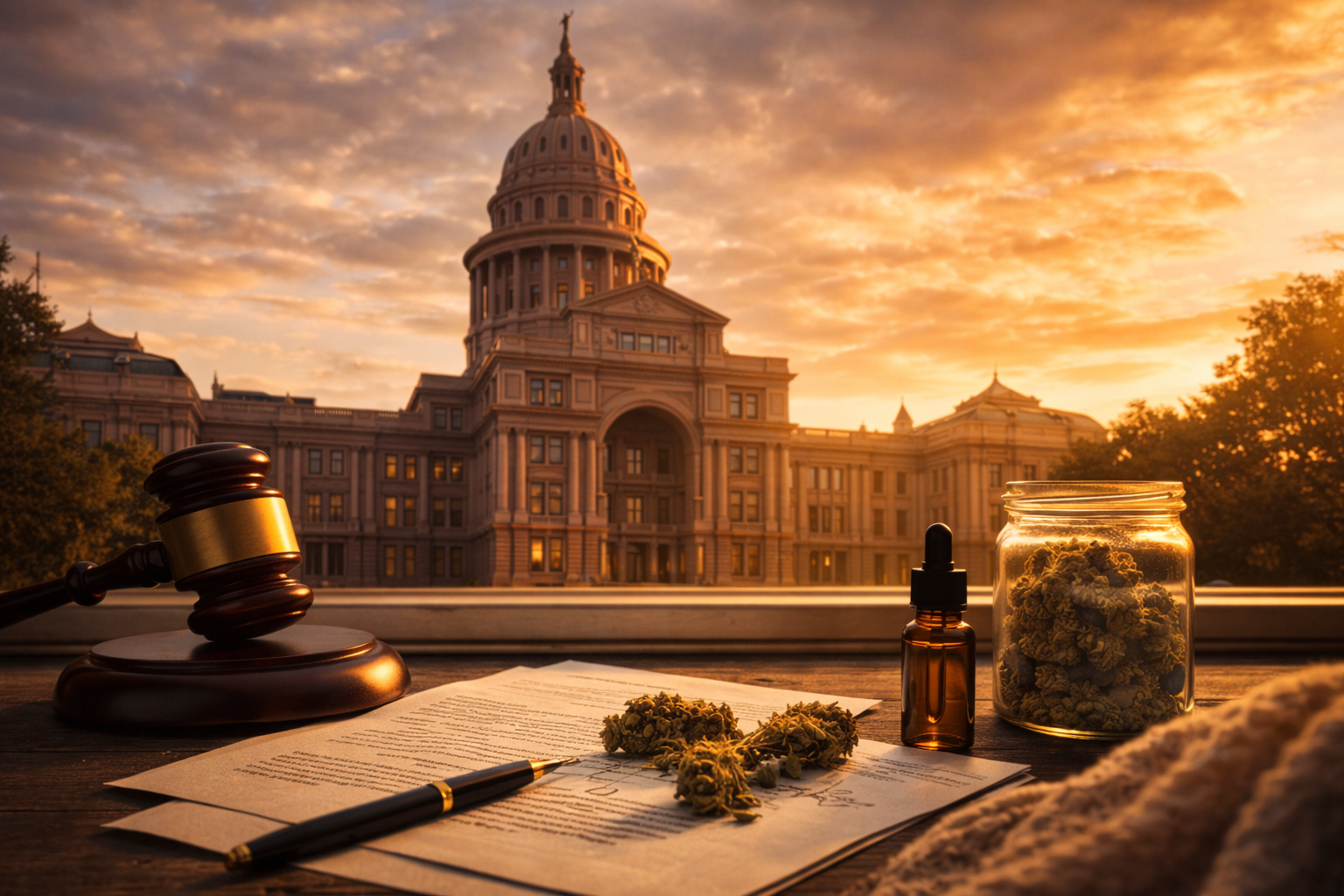
A Travis County district judge issued a temporary restraining order blocking enforcement of Texas DSHS rules that effectively banned smokeable hemp products. Judge Maya Guerra Gamble ruled in favor of the Texas Hemp Business Council and several hemp businesses, allowing the sale of THCA flower and hemp joints until at least April 23, when the next hearing is scheduled.
The DSHS rules, which took effect March 31, imposed a 0.3 percent total THC threshold that made most natural smokeable hemp products illegal, plus $10,000 annual licensing fees per facility and $5,000 per retail location. The hemp industry filed a 300-page lawsuit calling the rules an overreach.
The TRO also temporarily unblocked interstate sales but deferred the licensing fee question to the April 23 hearing. For Texas hemp businesses that were days from closing their doors, this is a reprieve -- not a victory.
Oregon: Cannabis in Hospice Becomes Law
Governor Tina Kotek signed HB 4142, requiring hospice, palliative care, and residential facilities in Oregon to develop policies allowing registered medical cannabis patients to use their medicine. The law becomes operative January 1, 2027, with facility policies required by June 2027 and staff training by December 2027.
This is about dignity. A person in their final days should not lose access to the medicine that helps them manage pain, nausea, and anxiety because they moved into a care facility. Oregon joins a growing number of states -- Louisiana passed a similar hospital access bill this month -- recognizing that cannabis patients do not stop being patients when they enter institutional care.
Alabama: Five Years to a Dispensary
Alabama's first medical cannabis dispensary, Callie's Apothecary in Montgomery, is expected to open May 4. That is nearly five years after the state legalized medical marijuana. More than 40 physicians have been approved to recommend cannabis, and regulators say nine dispensaries operated by three licensed companies should be online by this summer.
Five years from law to first sale. That is the cost of bureaucratic resistance. But it is happening.
Solana Breaks Out
SOL spiked to $86.60 on April 14, up 6.2 percent from $81.53 the day before. The token finally reclaimed the $86 level where the 20-day moving average sits -- the first sign of bullish structure returning since the decline from October highs. Whether this holds or fades will depend on follow-through volume, but for the first time in weeks, the chart is pointing up.
For the Weedcoin OG community, the timing is fitting. Five days to 4/20. The market and the movement are both showing signs of life.
5 Days to 4/20
Five days. The Army marijuana waiver takes effect. The Medicare CBD hearing is scheduled. Texas hemp businesses just got a lifeline. Oregon hospice patients will finally keep their medicine. Alabama is about to open its first dispensary after half a decade of waiting.
And 40 million Americans with anxiety disorders deserve to know that the research says CBD works -- but the dose matters, the form matters, and the honest answer is more useful than any headline.
Rise above the stigma.
Stay connected with the Weedcoin OG community:
Website: https://www.weedcoinog.com
Follow us on X: https://x.com/weedcoinog
Chat With Wiz (GPT): https://bit.ly/ChatWithWeedcoin
Contract Address: 21nnfR4TkbZNLwvRrqEseAbz7P3kxKjaV7KuboLJpump
Like bitcoin but way higher 🌿